
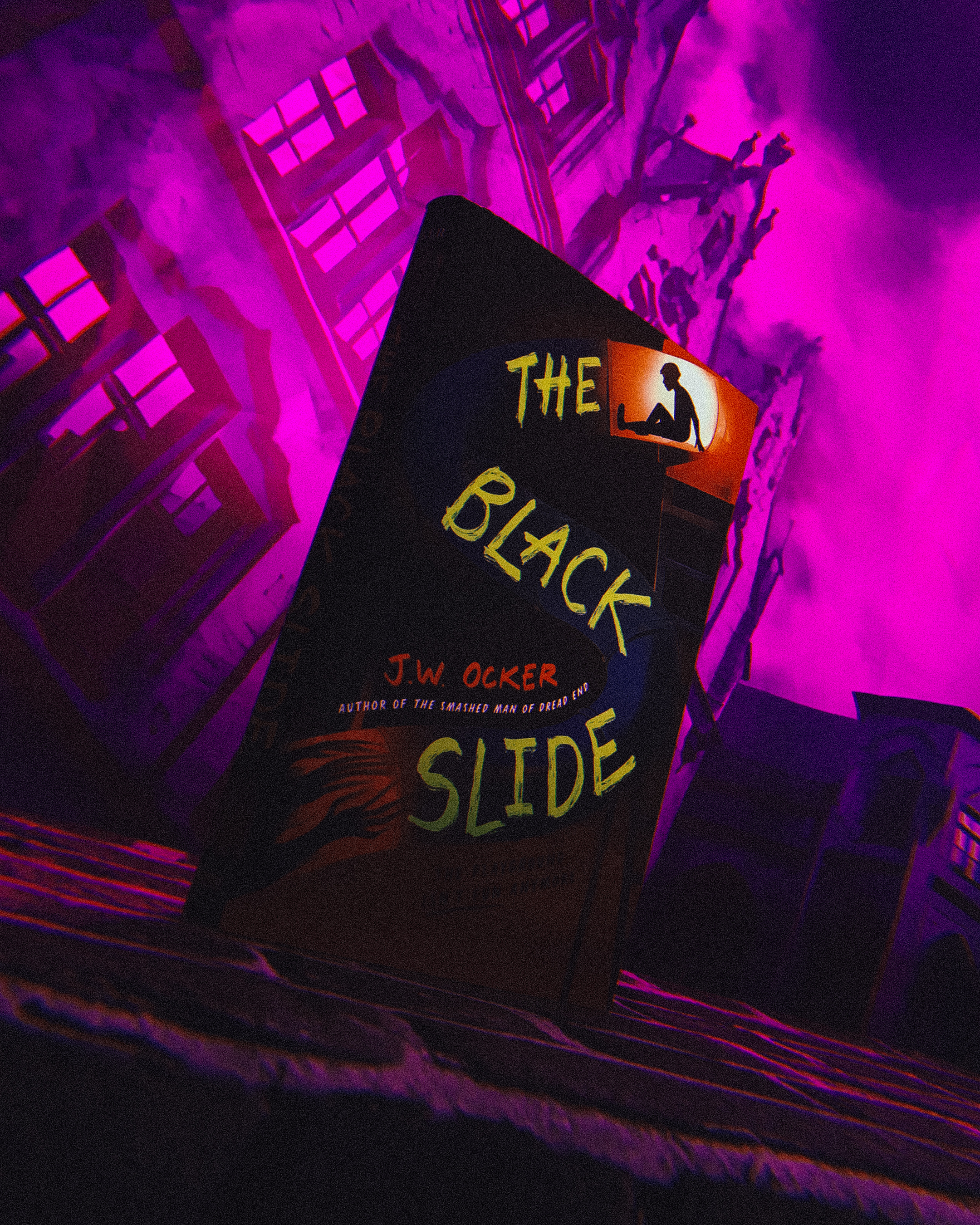
 No one in Griffin Birch’s class could say when the Black Slide showed up on their playground. One day, it was just there, replacing the old one.
Griffin couldn’t tell you why the Black Slide makes him feel so uneasy, either. Maybe it’s the way it always seems to be the same size, no matter how close or how far you are from it. Perhaps it’s the way it looms over everything else in the playground, like a predator, patiently awaiting its prey. In either case, he doesn’t want to get near the thing.
But the promise of reprieve from constant bullying compels him to go down it one day. The slide seems interminable, with Griffin seeing things inside the darkness of the duct that shouldn’t be possible. After what feels like an eternity, Griffin comes out of the slide with a broken arm and fear deep inside his bones.
Shortly after, students start to disappear. Griffin sees them from his classroom window, walking up to the Black Slide as if in a daze. They climb up its chrome stairs, enter its obsidian cylinder, and they don’t come out. Weirder still, none of the adults around him seem to notice the missing children.
And it’s only when his best friend Laila is one of those who disappears down the Black Slide that Griffin gathers up the courage to follow.
What they find on the other end of the slide is a world of pain, inhabited by creatures that revel in it and are all too eager to share their suffering.
As I was updating my Goodreads profile soon after finishing J.W. Ocker’s The Black Slide, I stumbled upon a comment from the author himself, mentioning how he wanted to push the boundaries of middle grade horror with this novel. Mission certainly accomplished, because this goes places that even I, a huge advocate for children’s horror being no less horrifying than adult horror, was taken aback at times. “Hellraiser for kids” is an apt description indeed, but while that series is more interested in the physical, visceral aspects of horror, Ocker wisely focuses more on the psychological side of things. His characters still go through physiological trauma, to be sure, but the descriptions deal with how their ordeals feel instead of anything that’s overly explicit, which is much more affecting in the long run. Our morbid, reptilian brain can—and will—fill out the rest.
But it’s a testament to Ocker’s writing that, in a story full of endless torment, the real horror does not come from the creatures whose existence revolves around the torture of children, but from the wanton, casual cruelty that people can—and so often do— inflict on one another. There’s a particular scene here involving Griffin’s estranged, abusive father that’s more shocking and terrifying than anything Ocker’s scaled-down Cenobites could ever conjure up.
Despite a second act that feels somewhat slow and repetitive, I loved pretty much everything about The Black Slide: from its captivating characters to its brilliant and nightmarish world-building (which at times reminded me so much of my own nightmares that I would actually physically recoil), to its themes. This is a story about friendship and resilience. It’s also a story about pain. And while there are countless children’s stories that deal with hardship, I’m hard-pressed to think of many that contend with just how often pain can—for better or worse—play a significant part in personal growth. This is a middle grade novel that faces that notion head-on, and as such isn’t afraid to explore some dark, disturbing places. Ocker navigates these gloomy spaces with tremendous nuance and compassion, all the while respecting his intended audience enough to never be coddling or condescending. Important and necessary.
 ricardo reading