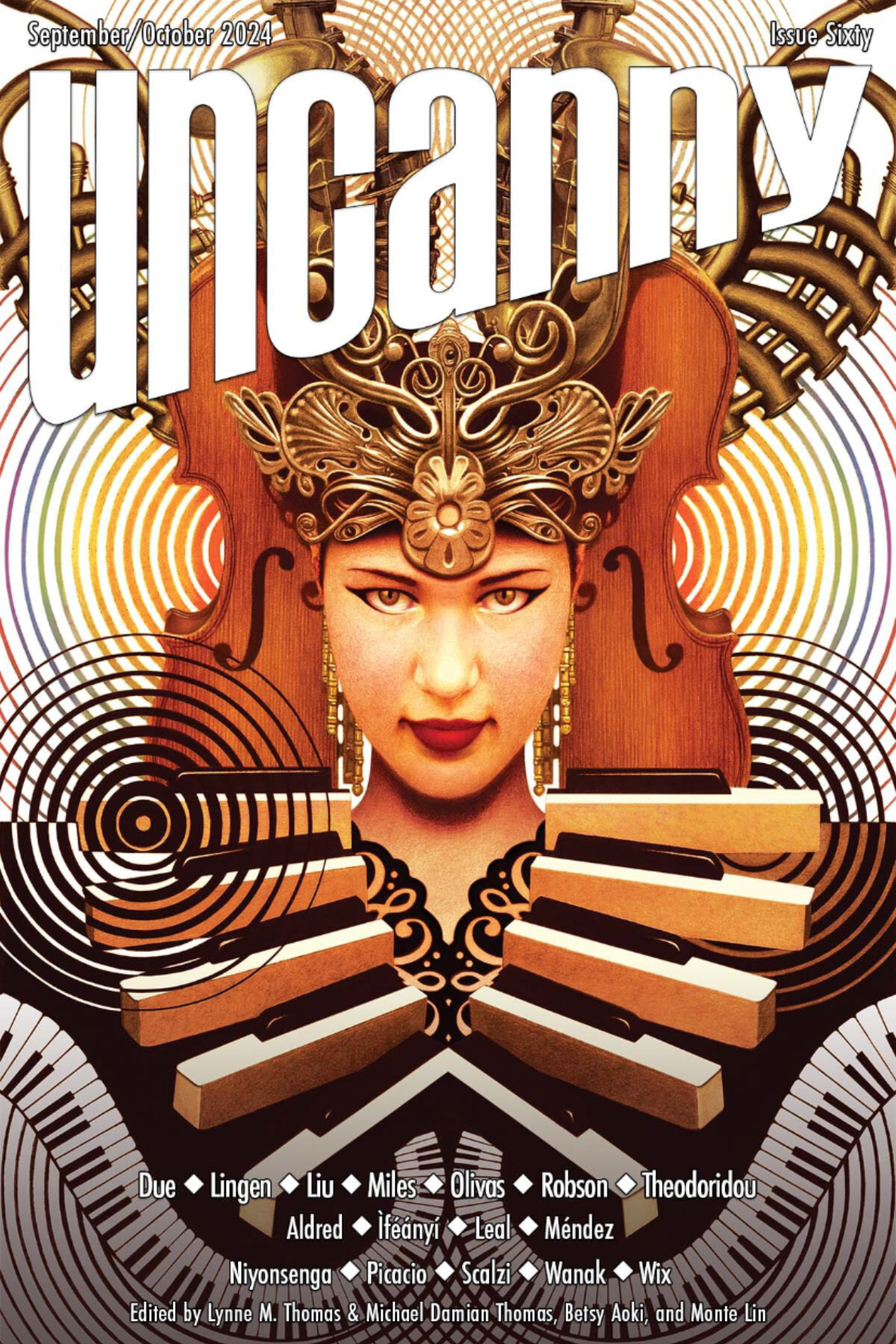
OCTOBER 2024

Hello. You know the books I read during the month of October because I did an individual review for every single one of them. Like a madman. But I also managed to read a bunch of short stories throughout the month, and I want to talk about them, too. So here we are. (Also it gives me an excuse to post a picture of a very satisfying pile of books. My gloriously garish Hallowe’en display.)
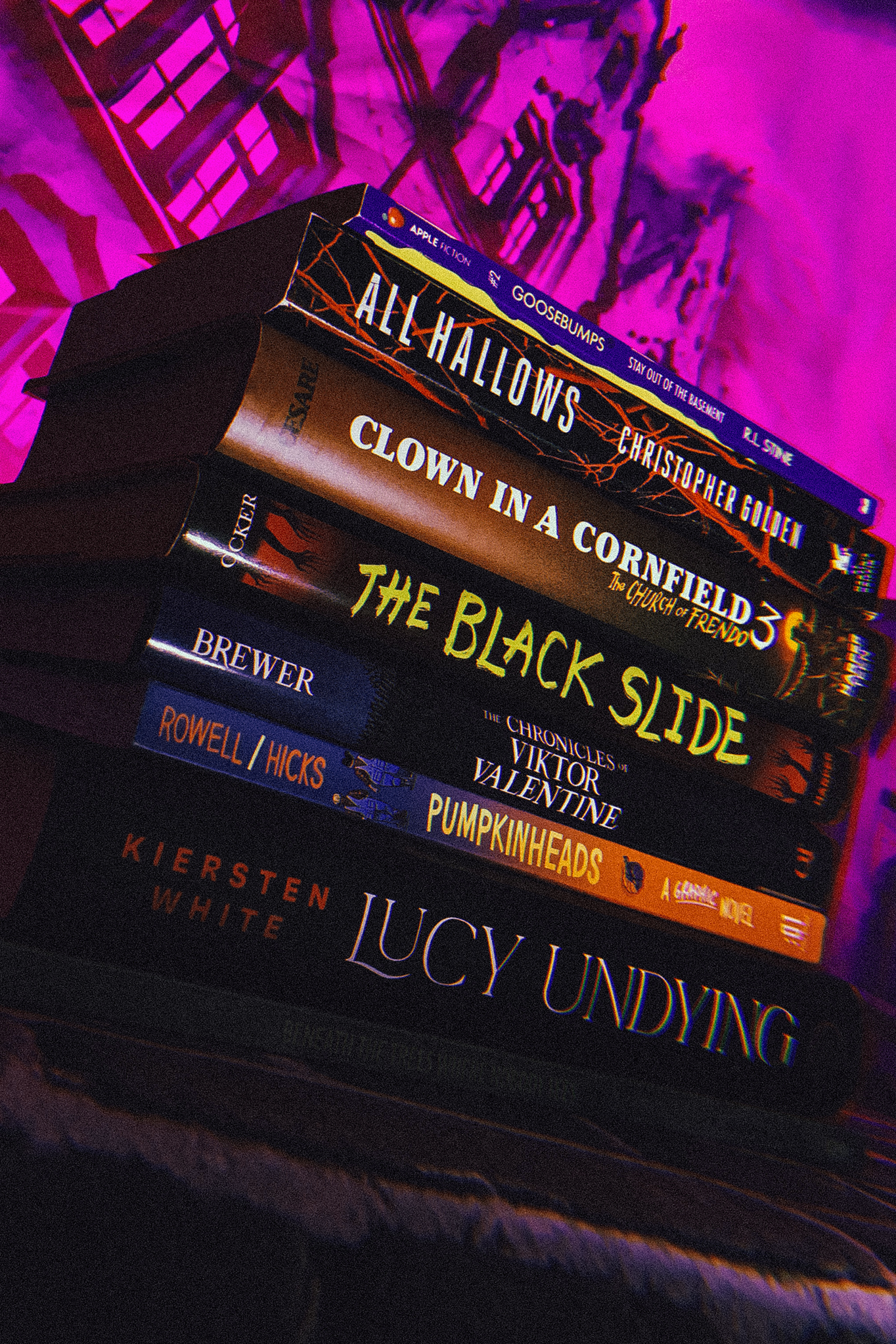
The books, in case you missed them: 

Beneath the Trees Where Nobody Lives by Patrick Horvath. Wonderful!

The Chronicles of Viktor Valentine by Z Brewer. Fine!

Clown in a Cornfield 3: The Church of Frendo by Adam Cesare. Disappointing!

The Black Slide by J.W. Ocker. Amazing!

Lucy Undying by Kiersten White. Glorious!

Stay Out of the Basement by R.L. Stine. Fun!

All Hallows by Christopher Golden. Great!

The short stories:

“Parthenogenesis” / “Wait for Night” by Stephen Graham Jones. Would you believe that these are the only things I’ve read by Jones? Neither can I. Really need to get on that. Anyway, “Parthenogenesis” was a fun story with a super creepy atmosphere, but I felt like the ending was a bit of a cop-out. “Wait for Night” was just a simple and super rad vampire tale. 

“A Stranger Knocks” by Tananarive Due. Didn’t realize this was a vampire story when I first picked it up, but I do love a serendipitous theme. Similar to the Jones situation, this is the first story I’ve read by Tananarive Due. Definitely need to pick up more of her stuff because this was excellent.

“The Tell-Tale Heart” by Edgar Allan Poe. My shameful secret that would surely get my goth card revoked if it ever got out is that I’ve barely read any of Poe’s actual work. “The Raven,” sure, the odd story here and there—but, like with most artists I admire, I’m far more interested in their cult of personality first and their work second. It’s something I’ve been gradually realizing is a serious disservice to said artists, so I’m working on fixing that. Anyway—this was brilliant, obviously. I read it in a collection called Darkness There, a Kindle in Motion affair that I’ve had on my tablet for years. It’s a neat concept, and features some wonderful art by M.S. Gorley, whose work—and name—evokes Edward Gorey’s (another cult of personality from my personal canon).

“Lantern Jack” by Christopher Fowler. More of a monologue than a proper short story—but it’s a damn good monologue, which made it a delight to read. Very cool, very clever, very macabre. Very into it. Read from The Mammoth Book of Halloween Stories.

“Everybody Is in the Place” by Emma J. Gibson. Some great atmosphere here, but I found the writing style seriously grating. There’s this constant repetition of words that I guess is supposed to evoke some sort of whimsicality (“We’re running, running, running!”) but it only comes across as awkward and annoying, particularly when it’s done so often in such a limited amount of space.

“A Forest, or A Tree” by Tegan Moore. Impeccable and creepy atmosphere throughout, along with some good character work. It’s too bad that it’s all undermined by an abrupt, hasty ending. As is the case with a lot of Tor.com Originals, this felt too much like the opening of a novel, rather than the closing chapter of one.

“The V*mpire” by P H Lee. This is a short story about Tumblr, of all things. It’s also a story about identity and community. And it’s a story about vampires. It should be a mess, by all accounts, but this was a surprisingly intense and impactful piece. Of course, it probably affected me more because Tumblr was such an integral, formative part of my 20s. I was too old to be part of the social circles depicted here, but I was certainly aware of them and can say that, for better or worse, their representation here is entirely accurate—from the compassion right down to the toxicity. This is also a story about how easily predators can exploit the openness of these often vulnerable communities by appropriating their particular language for their own malicious means. The vampires in this story may be fictional bloodsuckers, but that doesn’t make them any less real.

“Bone Fire” by Storm Constantine. Another one from The Mammoth Book of Halloween Stories. My notes for this story read, “A fae and dusky little story. This very much felt like what I imagine a huge bonfire on Samhain must have felt like.” I have absolutely no idea what that means, but let’s go with it. 

(I should note that I often write my notes immediately after I finish reading a story, so they are very much a first impression kind of thing. It also means that they are almost always nonsense. Alas.)

“The Folding Man” by Joe R. Lansdale. A truly outlandish mix between an odd urban legend and, like, The Terminator. Simple, straightforward, and at times seriously savage story. I was super into it. Read from The Mammoth Book of Halloween Stories.

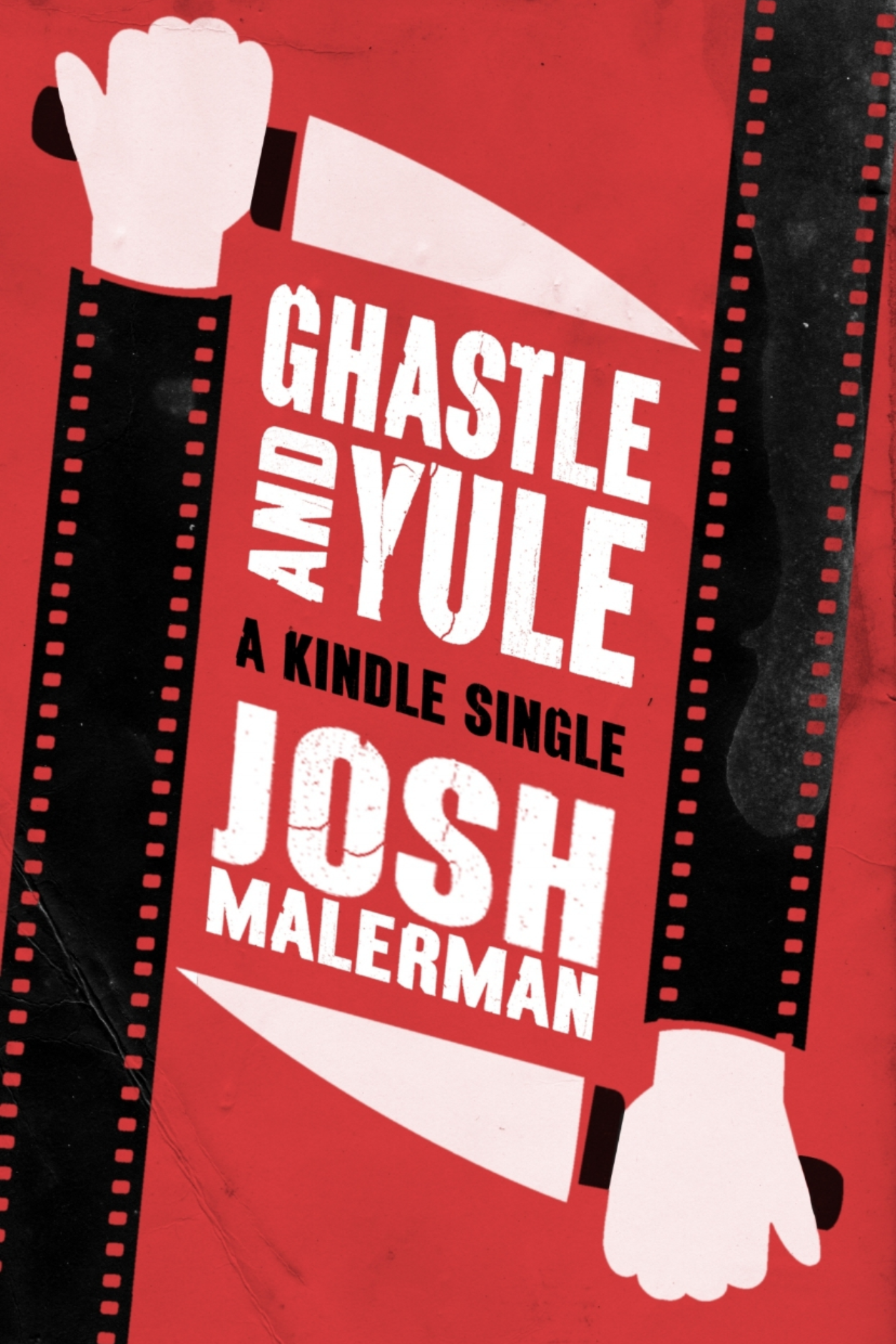
“Ghastle and Yule” by Josh Malerman. Despite its name, this was not a creepy Christmas story as I originally expected. Instead, it’s a tale about two rival horror filmmakers and their obsessions with both their craft and with one another. I enjoyed it a lot. The writing does leave a lot to be desired, at times—there’s more than a fair share of clunky, awkwardly phrased sentences—but the story itself is fascinating enough that I can easily forgive those shortcomings. I’ve always loved stories about film productions, particularly of the Old Hollywood and Mid-Century eras. This skews heavily towards the latter half of the fifties and early sixties, but it hit all the right notes for me. I was particularly impressed with Malerman’s world-building, which is so thorough and convincing that I found myself Googling the names of the characters and some of the film titles to see if they were real. Intriguing, morbid, and a lot of fun.

“The Ultimate Halloween Party App” by Lisa Morton. This one has a great and pretty terrifying premise, but it ultimately didn’t do much for me. The world-building felt cobbled together from interesting but half-formed ideas that never really meshed well. The ending, in particular, felt like a huge non-sequitur—as if the author got bored with her own story. Very baffling. Read from The Mammoth Book of Halloween Stories.

And finally, one book I did not do an individual review for, because I’ve written about it more than enough times

Pumpkinheads by Rainbow Rowell, Faith Erin Hicks. A seasonal staple, obviously. I used to pick this one up at the very beginning of October but have since realized that it’s actually the perfect transitional read, being set on the last day of the month and all about endings and new beginnings. It literally concludes with the characters talking about taking up seasonal jobs during the holidays. Which brings me, once again, to ask Rowell and Hicks for a Christmas sequel to this beautiful book. Please. I beg. I implore.

And that’s another Hallowe’en season come and gone. I hope you all had a good one. I did, despite feeling at times as if I was forcing it a bit too much. (Really, is there anything more horrific than Life getting in the way of your enjoyment of frivolous things? I submit that there is not.) But in the end, I watched some fun movies, read some damn fine stories—even wrote one of my own—and I can’t ask for anything more than that.

ALL HALLOWS by Christopher Golden

Publisher’s summary: It’s Halloween night, 1984, in Coventry, Massachusetts, and two families are unraveling. Up and down the street, secrets are being revealed, and all the while, mixed in with the trick-or-treaters of all ages, four children who do not belong are walking door to door, merging with the kids of Parmenter Road. Children in vintage costumes with faded, eerie makeup. They seem terrified and beg the neighborhood kids to hide them away, to keep them safe from The Cunning Man.

There’s a small clearing in the woods now that was never there before, and a blackthorn tree that doesn’t belong at all. These odd children claim that The Cunning Man is coming for them… and they want the local kids to protect them. But with families falling apart and the neighborhood splintered by bitterness, who will save the children of Parmenter Road?

🎃

All Hallows is a definite slow burn. Author Christopher Golden takes the Stephen King approach here, allowing us to get up close and personal with his sizable suburban cast—introducing first their personal demons before letting loose all the literal hellions.

The focus on interpersonal relationships might not resonate with some readers, though, as it does mean that for a large portion of the book, the horror is much more of the domestic kind, with the supernatural elements only really kicking in well into the second half. While the social drama is very much the heart of the story—it’s compelling and, at times, considerably more harrowing than any of the horrific happenings that follow—the novel could have certainly benefited from a better balance overall. The otherworldly aspects are alluring and fascinating, but they also feel somewhat tacked on, with Golden throwing in a lot of lore significantly late in the game. Horror often thrives on mystery and ambiguity, yes, but if the goal is to establish a larger mythology, you’re probably going to need more than a handful of cursory paragraphs.

Still, the sudden supernatural shift sets us up for some seriously shocking scenes, made all the more impactful by the considerable amount of time we’ve already spent with these characters and their struggles. We empathize, and thus we are horrified. I found the Cunning Man and, in particular, the old-fashioned trick-or-treaters exceedingly creepy. The preternatural principles of the story may be a bit vague, but they do bring a lot of dark folkloric flair. They work for me.

That shadowy atmosphere is the best thing this book has going for it—something I fully expected after reading Baltimore, Christopher Golden’s magnificently Gothic collaboration with Mike Mignola, last year. Golden completely captures both the informal, ephemeral nature of the holiday and its more arcane, ethereal facet. The end result is a lot of ghoulish fun—a novel that evokes the playful spirit of Spirit Halloween just as much as it does the mythical essence of Samhain—making All Hallows, for this reader at least, the perfect read to close out the All Hallows season.

BALTIMORE by Mike Mignola, Christopher Golden

The Great War on a cold autumn night.  Captain Henry Baltimore is charged with a suicidal mission: to somehow lead his battalion across the notoriously impassable No man’s land. Indeed, they barely make any headway before being ambushed by the hidden Hessians. Later, Baltimore awakes atop a mountain of his massacred companions, with carrion-scavengers already circling overhead. Baltimore quickly realizes these are no ordinary birds of prey, but monstrous bat-like beings. He manages to wound one of them while trying to escape, but not before the creature mangles one of his legs, breathing into it a pestilent substance that soon renders it useless.

The brief encounter between man and monster ends up changing the course of not only Baltimore’s life, but the world’s. As the war comes to a close, a mysterious plague begins to spread all across Europe, leaving ghost towns in its wake.

It is to one of these ghost towns that Lord Henry Baltimore summons three of his acquaintances. They meet inside a ramshackle inn. The men do not know one another, the absent Baltimore seemingly being the only thread connecting them. While waiting for their associate, and lacking anything better to do in the drab, run-down place, they begin to tell stories, specifically about how they each came to be acquainted with the now nomadic nobleman. Stories that tell of Baltimore’s many losses. Of the man’s belief that he had awakened something sinister and supernatural during the war. Of his slow, painstaking transformation into a cold, ruthless warrior, fighting shadows in plague-ridden places.

And they tell their own stories in turn. Of the odd, ghastly events witnessed over the course of their lives. Of the experiences that led each of them to believe, unequivocally, in Lord Baltimore.

🎃

Well, I enjoyed the hell out of this.

Baltimore, or, The Steadfast Tin Soldier and the Vampire by Mike Mignola and Christopher Golden is one of those stories I tend to think of as “damn good yarns” upon finishing. Written in the same style and spirit of the Victorian era literature that has shaped and influenced much of Mignola’s work, Baltimore is a baroque, thoroughly Gothic tale that revels in its ornate, ostentatious nature. Like many of its purple predecessors, it exudes atmosphere in abundance, and, as a reader for whom this quality often reigns supreme, this book managed to hit all the right spots for me.

As the lengthy alternate title suggests, Baltimore is a re-imagining of “The Steadfast Tin Soldier” fairy tale by Hans Christian Andersen. Mignola and co-author Christopher Golden wisely preserve that story’s melancholic poignancy, making it the beating heart of their own tin soldier, while at the same time decking the rest of the story out in somber, funereal vestments. Instead of paper ballerinas, there is a dead spouse. And instead of a goblin jack-in-the-box, there are vampires.

Ironically, it’s those two elements that end up slightly hindering the book. Baltimore is very much a boy’s tale, with women featured in only the most peripheral of ways. It would have benefitted the story to give at least Elowen, Baltimore’s wife, an expanded role, considering she is his primary motivation. Instead, much like the ballerina in the original tale, her characterization is mostly paper-thin.

As for the vampires, I just found the lore around them muddled and lacking. You get the sense that Golden and Mignola wanted to go the Our Vampires are Different route, which is commendable, but given that most of this book — from the themes to the style in which it is written — adheres fairly strictly to traditional approach, makes this a somewhat odd choice.

But the appeal for me ultimately lies in the storytelling, at which this book spectacularly succeeds. Most of Baltimore is told as a nested narrative, courtesy of our three protagonists, who pass the time by telling stories, with each tale showcasing just how memorable and varied weird fiction can be. The story within a story is a device I particularly love, so of course this was the aspect of the book I enjoyed the most.

Nearly all of the pages boast woodcut-like illustrations, drawn by Mignola in his distinctive, striking style. They’re a little plain, but Mignola’s art has had a huge influence on me over the years, so it’s always a joy to see.

A damn good yarn, indeed.