October is my best reading month. I’m a very seasonal, themed-oriented reader, and Hallowe’en, more than any other holiday, lends itself to these qualities pretty perfectly. I cut loose and read books that are a bit more fun than my usual fare, which makes it really easy to pick up book after book after book, something that I definitely don’t do in any other month of the year.
This particular Hallowe’en, however, felt a little off. It was to be expected considering, well, everything, but I guess I was just confident the holiday would lift my spirits up — it did during the harrowing aftermath of Hurricane María, after all. But as tragic as that event was, this pandemic is obviously so much worse and I foolishly ended up underestimating just how much it would affect my mood.
Add to that the fact that I decided to go all in on my bookstragram for Hallowe’en, wanting to put out pictures and reviews on a more or less consistent manner throughout the month. I succeeded, too, and I’m happy and proud I did it, but it was draining, and that sucked a bit of the fun out of it a bit.
I still ended up having a tremendous amount of fun, though, and I read a lot of damn fine books. I’m sad to see the spooky season go, but we all know that 𝖍𝖆𝖑𝖑𝖔𝖜𝖊’𝖊𝖓 𝖎𝖘 𝖊𝖙𝖊𝖗𝖓𝖆𝖑 anyway.
 PUMPKINHEADS by Rainbow Rowell, Faith Erin Hicks
I first read this graphic novel by Rainbow Rowell and Faith Erin Hicks when it came out last year. It didn’t take much for me to love it. So much so that I decided I would start a new tradition of reading it at the beginning of every October from then on. Because while the month to me mostly means spooky, atmospheric books and vibes, it also means fresher, gentler nights spent in warm nooks and beds. I want to start the month with something just as cozy and pleasant, and you’ll not find a more comfortable, delightful — more autumnal — book than Pumpkinheads. ⠀
⠀
I loved it just as much this time around. That’s usually the case with stories written by Rainbow Rowell. She writes charismatic, immediately lovable characters, and Josie and Deja, our titular pumpkinheads, are some of her most charming yet. I really fell for them both, and I finish this story always wanting to know more about them. I want to read about their past pumpkin patch adventures just as much as I want to read about whatever future they have. I want to know what they’re up to. ⠀
⠀
Faith Erin Hicks’ art I’ve long been a fan of, and she brought her A game to this graphic novel. I love the world she’s drawn up here, which feels just as lush and warm and inviting as it did on my first visit. And colorist Sarah Stern (whom I failed to mention in my first review) has, in the opinion of this tropical, Caribbean boy, created the quintessential fall palette. This book is now pretty much what I picture whenever I think of the season. ⠀
⠀
Pumpkinheads, for me, acts as the perfect bright, light entrée before the headier, spookier course lined up for the rest of the month.
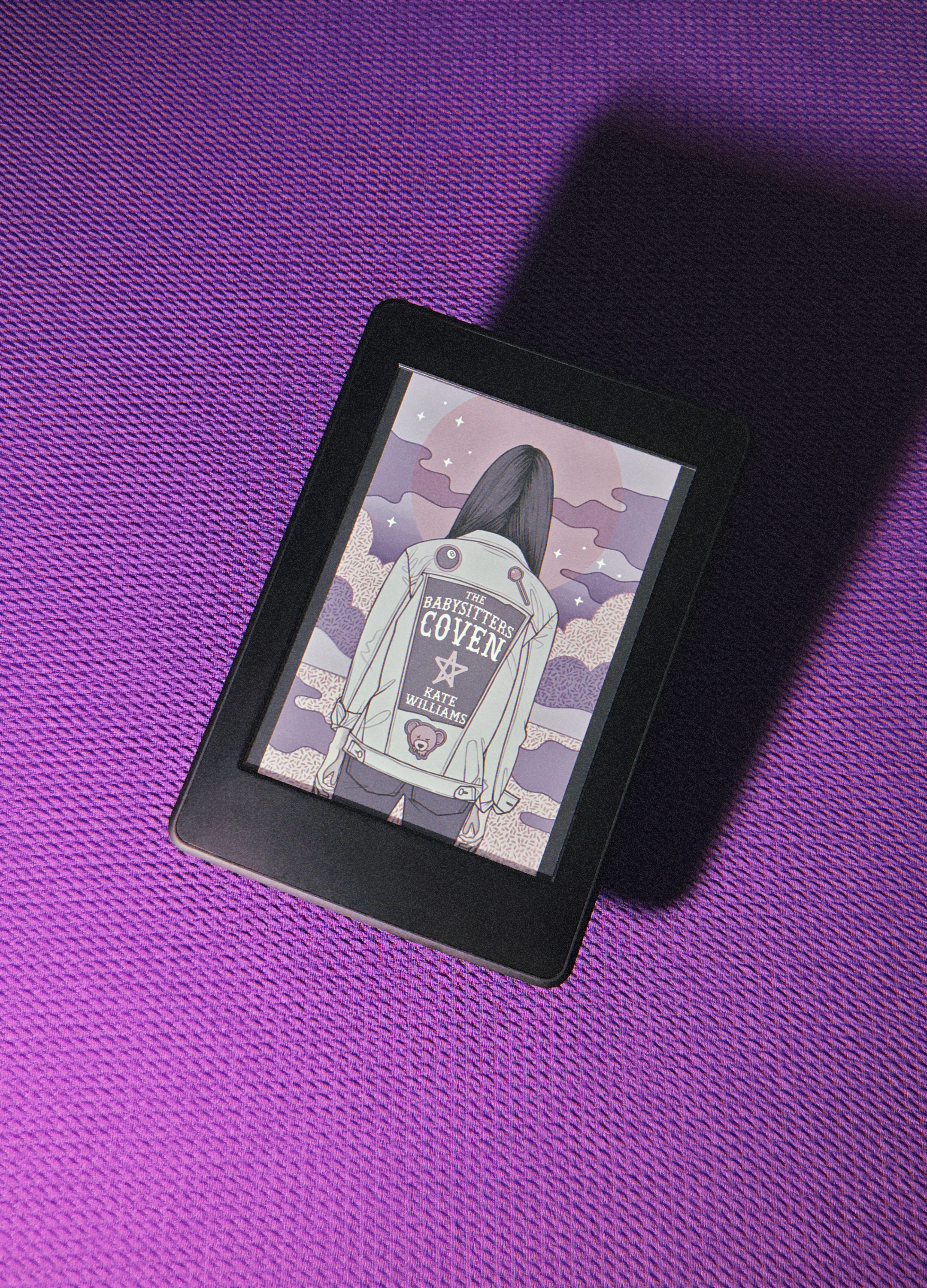 THE BABYSITTERS COVEN by Kate Williams
The Babysitters Coven didn’t do it for me at all.⠀
⠀
A shame, really. The novel has a promising premise (The Baby-Sitters Club meets Buffy the Vampire Slayer) and a strong, genuinely unsettling opening chapter. I was fully on board with it. But it unfortunately turned out not to be as fun as any of its initial inspirations, and any tension and mood set by the beginning quickly dissipates as the story turns from what seemed to be the start of a supernatural thriller into a prosaic high school pariah account. What little energy it regains as it slogs through the first act is again stopped dead in its tracks halfway through by an infodump sequence so egregious that it almost made me drop the book entirely.⠀
⠀
It’s a story that wears its influences on its flowy, Stevie Nicks sleeves, too, something that, when done well, I tend to appreciate. Here, though, these inspirations only act as reminders to the reader that there are better stories out there, so why aren’t you enjoying them instead?⠀
⠀
It’s also, bizarrely, not remotely as witchy as the title and the excellent cover make it out to be? I think there are only two mentions of witches and covens in the whole thing? The characters are more Eleven from Stranger Things and Charlie from Firestarter than they are the badass weirdos of The Craft, which is sort of what’s promised? Where was thy witchy goodness, book???
 DEVOLUTION by Max Brooks
Reading Devolution by Max Brooks turned out to be a pretty physical activity for me. At numerous points I would put my Kindle down to pace relentlessly around the room for a while before picking it up again. At others I would alternate between tossing and turning in bed and just straight up yelling at the book. I read it in two days, finishing it with a seven-hour spree, and it kept me, quite literally, on the edge of my seat (or mattress, rather) the entire time. ⠀
⠀
It was downright exhausting. And also a hell of a lot of fun.
The colony of Greenloop is a modern marvel. Situated between the Cascades in Washington, this eco-community boasts all the comforts of modern city living in the midst of all the rugged beauty of the wilderness. Each dwelling is a smart house, powered by sunlight and biogas. If there are technical issues, a signal is sent to a nearby town where technicians and specialists will go up in self-driving vans to do any repairing. High-speed internet is, of course, readily available, and the residents can simply telecommute to work. Supplies and groceries are delivered weekly by drones. It is, by all accounts, a techno-utopia. A proverbial paradise.
Until nearby Mt. Rainier erupts, and while the compound is far enough away from the volcano to be safe from the initial blast, volcanic mudflow soon blocks the roads, while ash and debris interrupt any internet access and mobile reception. The remote, isolated Greenloop community is cut off from the world, and its residents — affluent urbanites for the most part — find themselves wholly unprepared for the events that follow. They have only a week’s worth of groceries, no tools, no survival skills of which to speak, and winter is fast approaching… bringing with it inconceivable primal terror.
⠀
Devolution is truly a wild, tense ride. In the vein of Jurassic Park, it’s a bloody — often gory — cautionary tale of human hubris. Of what happens when we convince ourselves we are masters of nature. Of the dangers of relying too much on the comforts of technology.⠀
⠀
As in Brooks’ previous novel, World War Z, much of the horror comes not from the monster but from the notion of just how easily the systems that we depend on can simply just… fail. Not just automated, mechanized systems, either, but social structures as well. Civilizations, Brooks’ novels remind us, can crumble just as easily as computers. A prospect more terrifying than any monstrous creature.⠀
⠀
Which isn’t to take away the spotlight from this book’s Sasquatch star. Bigfoot is properly terrifying here, and I appreciate how much effort and attention Brooks devoted to portraying it like an actual animal rather than some uncanny supernatural being. Any time you can inject some semblance of reality into your horror story will always make it that much more striking, and a creature that’s after you because it’s hungry rather than for any deliberately malevolent purpose… well, that just triggers some of our base, primal fears, from the time before we developed enough brains to fool ourselves into thinking that we somehow, through sheer will and determination, broke away from the food chain.⠀
⠀
I had a great time with this book. And it definitely cements Max Brooks as one of my favorite writers.
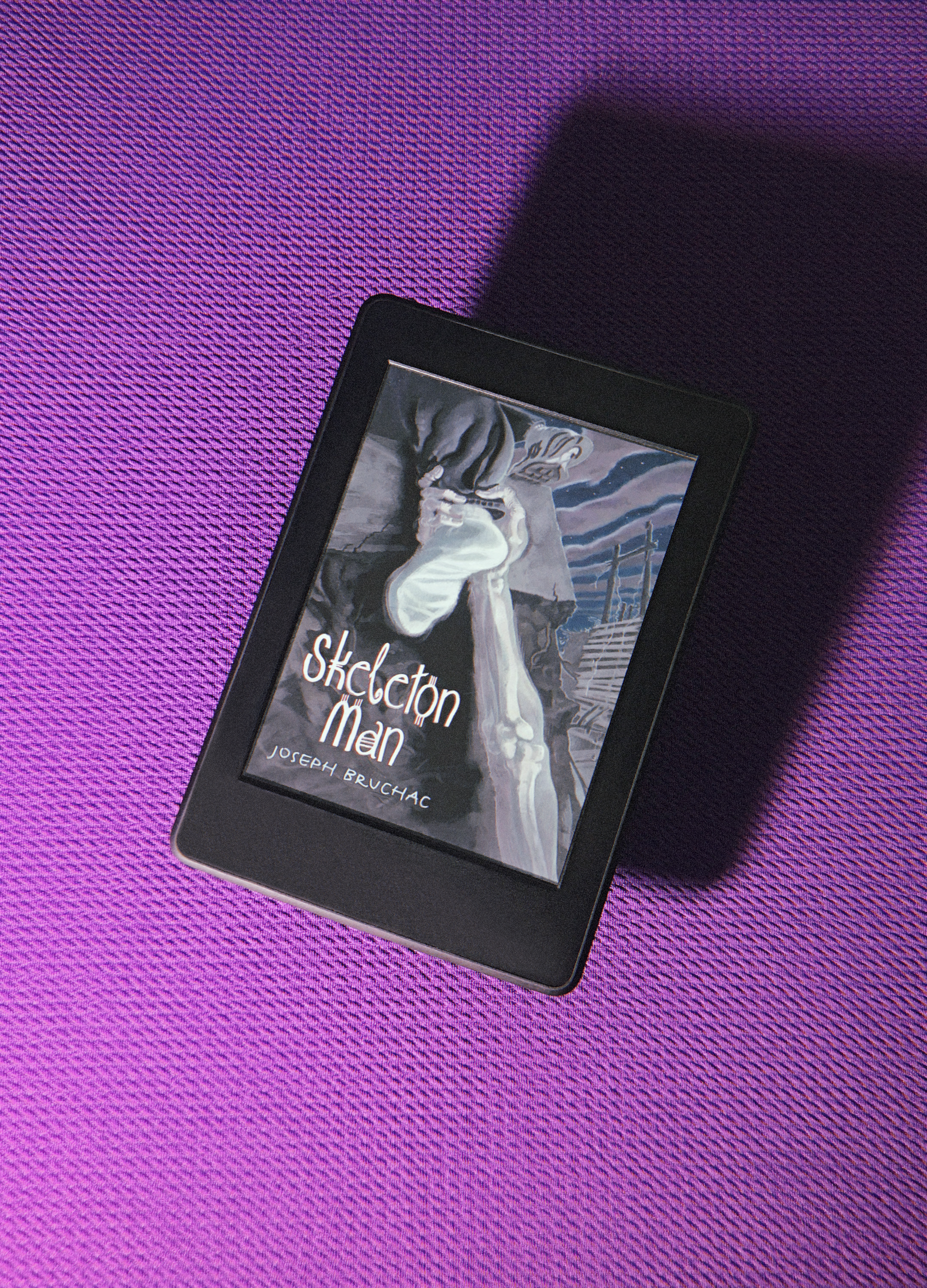 SKELETON MAN by Joseph Bruchac
Joseph Bruchac is an honest-to-goodness storyteller. Not just in the sense that he is a prolific author, but that he still participates in the storied tradition of actually getting up in front of people and telling tales.⠀
⠀
Prolific as he is, I only found out about him earlier this year, listening to an interview with Adam Gidwitz wherein he sang the praises of Bruchac (they co-wrote a book in the Unicorn Rescue Society series). I immediately looked him up and the first thing I found was an old video of him telling a story of “The Skeleton Man,” about a man so lazy that, instead of going out hunting for food with the rest of his tribe, he cooks and eats his own flesh instead, until he is nothing more than a skeleton. Still hungry, the Skeleton Man proceeds to eats the rest of his family as they return, until one of his nieces, with the help of some wildlife, stops him for good.⠀
⠀
It’s a deliciously macabre story, and one that Bruchac tells with enthusiasm and delight to a crowd of mostly kids, who react with shock and glee in equal measure. I was captivated, watching this man telling this old Native American tale to a similarly captivated young crowd. I looked up his works soon after and was thrilled to find that he had written a full book based on this same Mohawk fable.⠀
⠀
A modern retelling of the story, Skeleton Man follows Molly, a young girl who, after the mysterious disappearance of her parents, is forced into the care of an uncle she never even knew she had. The uncle keeps her locked in the room of his decrepit house, letting her out only for school and to eat, which he is particularly insistent she does. She soon realizes that her “uncle” may not be entirely human but an otherworldly being with sinister intentions.⠀
⠀
I enjoyed reading this short novel as much as I enjoyed Bruchac’s telling of the original story (which you should definitely look up). This contemporary rendition reads like a refined R.L. Stine, in the sense that, while ostensibly written for a young audience, it never talks down to them, and certainly does not shy away from the shuddersome aspects of this spooky tale.
Skeleton Man is also a celebration of the strength of women, in particular Native American women. Bruchac dedicates this book to “all the young women who have yet to discover the courage that lives in their hearts,” and then, in the acknowledgements, he goes on to note just how deeply and how often strong women feature in traditional American Indian stories, a sharp contrast to the more commonly patriarchal European fairy tales.⠀
⠀
Bearing that in mind, and the fact that I read this on Indigenous Peoples’ Day, I feel it’s important to recognize the current epidemic of missing and murdered Indigenous women presently plaguing North America. I include some pertinent links, and encourage you all to read up on this tragedy and to please consider donating to relevant charities.
 CLOWN IN A CORNFIELD by Adam Cesare
In the aftermath of her mother’s death, teenager Quinn Maybrook and her father are looking for a fresh start. They decide that moving from Philadelphia to the rural town of Kettle Springs, Missouri might just be exactly what they need. Instead of finding peace and quiet, however, they encounter a town brimming with tension between the older and younger generations, each side blaming the other for the community’s recent misfortunes. A conflict comes to a head during a high school party, where someone dressed as the town’s mascot — a forlorn looking clown — drops by for a homicidal visit. What follows is a confrontation between the cynical-yet-idealistic adolescents of the town and this sinister symbol of stagnant traditions — a fight that will not only determine their own survival but that of Kettle Springs itself. ⠀
⠀
Adam Cesare knew exactly what he was doing when he called this Clown in a Cornfield. It’s as evocative a title as you can get. So much so that you don’t even have to mention the book’s genre; our reptilian brain simply knows.⠀
⠀
HarperTeen knew exactly what they were doing, too, when they tapped artist Matt Ryan Tobin for the cover art, which, down to the color scheme and font, evokes everything from Zebra imprint’s line of horror in the seventies; to the Point Horror series in the nineties; up to more recent properties like Stranger Things. Mainly, though, it brings to mind the work of Stephen King — it’s a horror book about a killer clown, after all. The expectations have been set. You know exactly what you are getting into.⠀
⠀
Except you don’t. Not quite. You do get a consummately creepy novel about a clown on a killing spree, to be sure — and it succeeds at being an excellent one at that — but you also get a story that features sharp social commentary that is all too relevant in our current landscape. That it manages to do so without feeling heavy-handed, and without letting it get in the way of, well, all the gory fun, speaks volumes of Cesare’s deft writing. This is a quick read, fun and riotous on the surface, with a lot more beneath if you care to look. Bodies in the basement, as it were.⠀
⠀
It’s a story that’s dressed up in classic horror garb: from the setup to the premise to its euphoric exploration — and subsequent subversion — of established tropes. It’s all meant to feel familiar. What sets it apart, though, is that beneath that vintage veneer lies a thoroughly modern narrative about prejudice and hate; generational conflict and social strife. All the tensions of present-day dramas — which Clown in a Cornfield cuts right through, purposefully and methodically, with a circular saw.
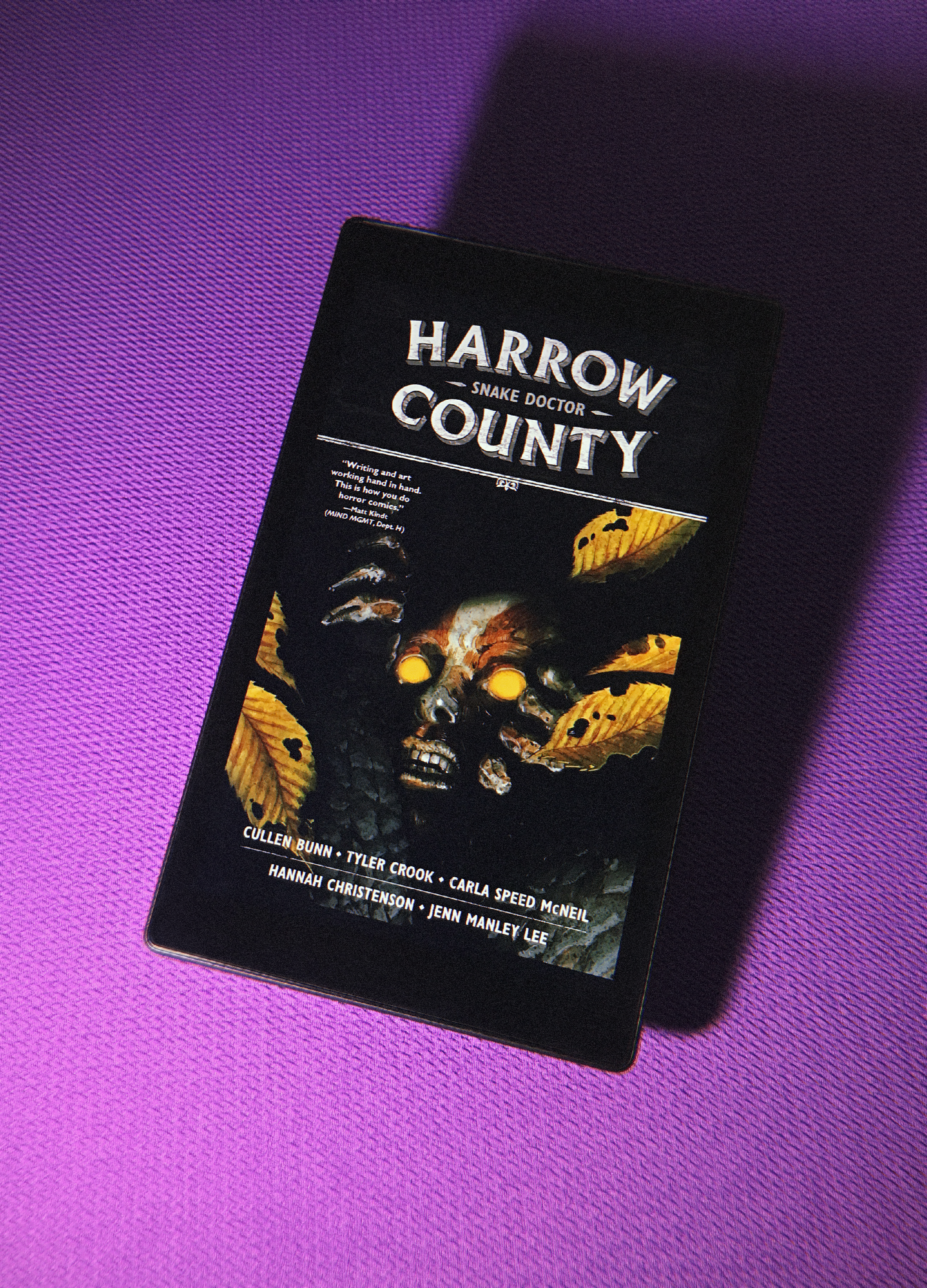 HARROW COUNTY VOL. 3: SNAKE DOCTOR by Cullen Bunn, Tyler Crook, Various
Harrow County by writer Cullen Bunn and artist Tyler Crook follows Emmy Crawford, a humble young woman who finds out she is the reincarnation of an infamous witch who was executed by the residents of Harrow after letting loose countless uncanny creatures — called haints — that went on to wreak havoc on the province. Feeling shunned from her peers, who fear retribution, she concentrates her efforts on demonstrating just how different she is from her past wicked aspect. The series progresses more or less with a monster-of-the-month format that is interspersed with a higher, more elaborate arc regarding Emmy’s power and identity. ⠀
⠀
I read the first two volumes of this series a couple of years ago for the Hallowe’en season and enjoyed them quite a bit. I failed to keep up with the comic, though, which meant that when I picked this ensuing volume I had a little trouble recalling what the actual story was about. But it’s a testament to Bunn’s writing that I felt caught up relatively quickly, pertinent details gleaned through context and dialogue. It helped, too, that this third volume (titled Snake Doctor) consisted mostly of standalone stories, with more of a focus on the secondary characters (the ghastly-but-sweet Skinless Boy, a haint and Emmy’s familiar, who gets an origin story of sorts here; and Bernice, her beleaguered best friend, who seems to be getting a larger story of her own in her dedicated issue). I had no problem getting invested once more in the characters and enjoying this set of issues.⠀
⠀
Harrow County is a gorgeous comic, with art and writing that is decidedly, deliciously lush (Crook handles the bulk of the art, but this volume also features the work of guest artists Carla Speed McNeil and Hannah Christenson who do a great job of shaking things up, visually speaking) and a tone that’s as ominous as it is welcoming (which I attribute to dialogue that just drips with congenial Southern charm). I hope to pick up the remaining volumes of the series soon, as it exudes a most appropriate atmosphere for the spooky season.
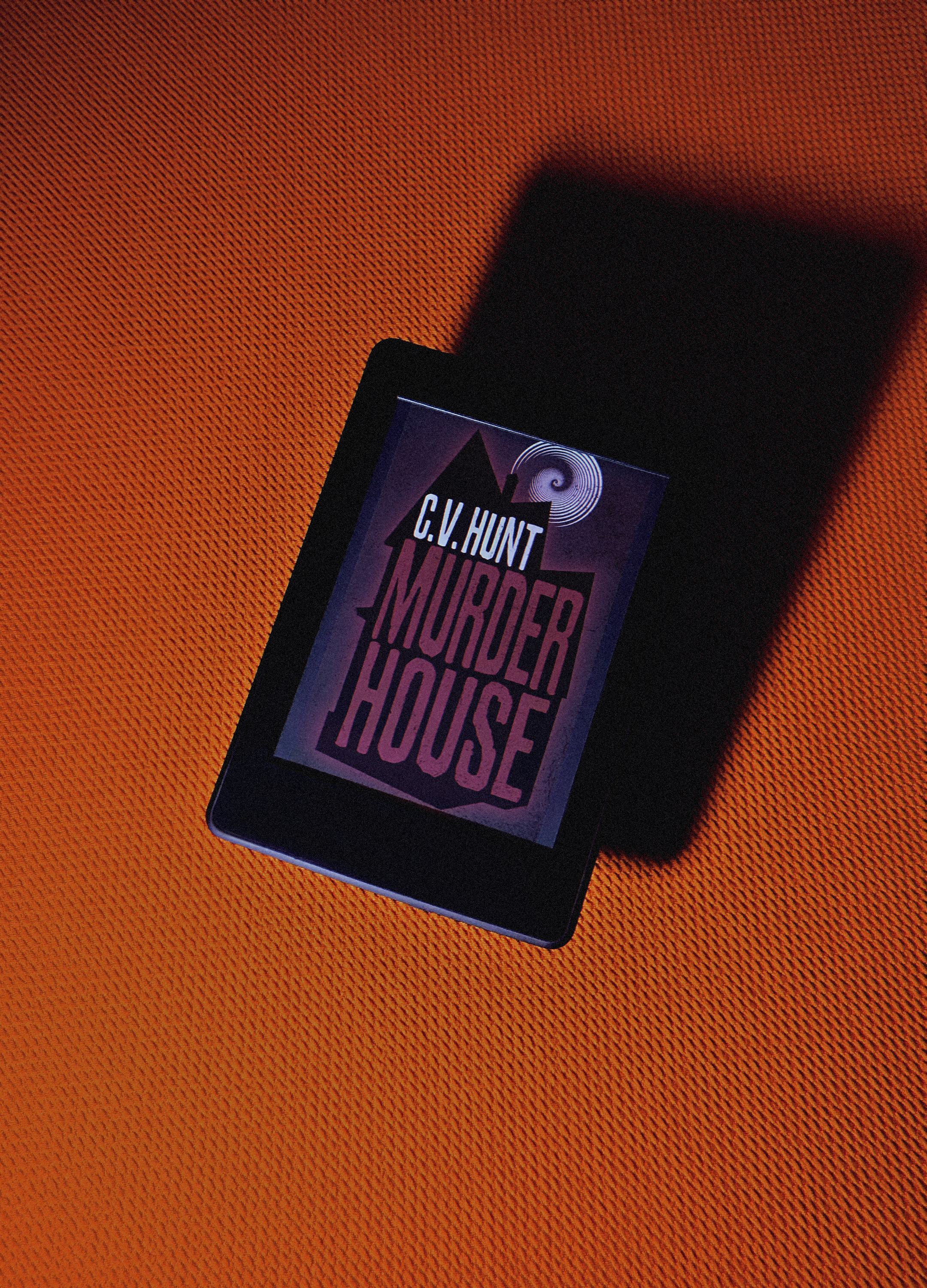 MURDER HOUSE by C.V. Hunt
C.V. Hunt writes a kind of horror I don’t typically go for. I tend to prefer scary stories that focus on atmosphere and carry more of a mischievous sense of playfulness. Hunt’s tales lean decidedly into the dark and gritty end of the spooky spectrum, featuring troubled, wretched characters who have been already put through the wringer of life before the horror that is to befall them even knocks on their door, as it were. Bleak stories about bleak people that, more often than not, end in a bleak manner. There’s a certain mindset I have to be in in order to properly appreciate this kind of fiction.
⠀
A mindset I must have been in when I read this slim novella recently because, while certainly dark and despondent, I found myself thoroughly compelled by it.⠀
⠀
Murder House follows Laura and her partner Brent as they move into a run-down house in a run-down part of Detroit. The building was the infamous scene of a particularly grisly set of murders about which Brent, a down-on-his-luck writer, is doing a book. Struggling financially, Brent convinced his publisher to let them live rent-free in the dilapidated digs during the writing process. Laura’s not too thrilled about the arrangement: for one thing their relationship is not at its healthiest point (to put it mildly) and she’s not certain it can survive the stress of maintaining a wreck; for another, the place itself just fills her with dread. She tries to be a supportive partner, regardless, but the inherent creepiness of the house soon begins to get to her. It eventually gets to Brent as well, and their already turbulent life threatens to veer entirely off the rails.⠀
⠀
I really admire how Hunt works with the haunted house aspect of the story. One of the primary plot points has to do with Laura having to stop buying her psychiatric medication in order to save money, (one of a handful of details that help make this story feel so grounded and real). She feels the effects of their absence at various points throughout the novella, which vary from mood swings to downright hallucinations. Hunt allows enough ambiguity here to make the reader question whether all the strange sights and sounds our protagonist keeps experiencing are the product of a haunted house or a haunted mind instead. Not a novel conceit by any means, but I appreciated Hunt’s empathetic approach to it: at no point does it feel exploitative; at no point does it feel as if mental health issues are being used for cheap thrills.⠀
⠀
The characterization here is notably strong, too. Brent and Laura both feel like real people — painfully so at times, with all their flaws and vulnerabilities. Laura in particular I found very well-realized, and the battles she’s fighting (both inner and outer) make her immediately endearing. You want her to get out of this horror story — out of this toxic relationship, out of this cursed house — relatively safe and unscathed. Murder House has other plans for our heroine, however, and it demands we bear witness.
 THE SOUTHERN BOOK CLUB’S GUIDE TO SLAYING VAMPIRES by Grady Hendrix
In the close-knit community of Charleston’s Old Village, Patricia leads a very sheltered and stale sort of life. Kept busy by her role as housewife and mother of two, she spends her days doing the countless crucial but uncelebrated things mothers often do in order to keep their families and homes afloat, but she still can’t help feeling unfulfilled and constrained. Her only outlet is the monthly book club she attends with a handful of other women in the neighborhood, wherein these prim, genteel Southern women read garish books full of murder and morbidity — books from which Patricia gets the kind of thrills she finds lacking in her small corner of the world. But she gets more than she wishes for one night after she is suddenly attacked by a deranged, elderly neighbor, an aggression that leaves her both physically and mentally scarred. Her protective bubble has been burst, and she senses that something evil and wretched has crawled its way in. Which is when the charismatic, handsome figure of James Harris descends upon the town, bringing with him desire and dread; disruption and upheaval; and more frisson than Patricia could have ever hoped for or wanted.⠀
There are so many things I enjoyed about The Southern Book Club’s Guide to Slaying Vampires, the latest from Grady Hendrix: what it brought to vampire lore, with James Harris being something halfway between the vampires in The Strain and Interview with the Vampire; how the vampire, in a sleek reversal of conventions, seduced not the women but their husbands, sweet-talking and stirring them into friendships and partnerships; how it’s told more as a thriller than a straight up horror novel, with the monster behaving like the serial killers the book club love reading so much about; how it condemned the casual, rampant misogyny of the men (in a book full of skin-crawling scenes featuring rats, cockroaches and other pests, the segment with the men shamelessly, relentlessly gaslighting and berating their wives stands as one of the most vile); how it provoked sympathy for Patricia, our persevering protagonist, right from the outset. Mostly I loved that Book Club, like every Hendrix book I’ve read so far, packed quite the emotional punch. ⠀
⠀
It’s not without its faults, however, mainly in regards to Hendrix’s handling of race, which leaves a lot to be desired. In many ways, this is a book about white supremacy (with Harris standing in as its ultimate symbol: a literal life-draining, racist, misogynist, uncompromising white man), about how the actions and inactions of a handful of wealthy white folk have great, detrimental effects on the marginalized communities around them. In the author’s note Hendrix writes about this book essentially being written from the point of view of his mother, who was a member of such a community, and that is a valid and interesting angle, but it also means that the harrowing experiences of Black people are perceived through the perspective of a privileged white Southern woman, and in a horror book where the bulk of the horror occurs to the mostly undepicted, unseen Black characters… Well, the optics aren’t great, to say the least.
To Hendrix’s credit he does try to acknowledge this problematic aspect near the end of the story, where the women of the book club recognize the consequences of their selfish actions — but it feels a little tacked on, and even then it comes accompanied with a hint of white saviorism. Again, not great. It’s a shame, really, as Mrs. Greene, the only major Black character, is terrific, and the story would have greatly benefited from being told, at least in part, from her perspective. Although it could be argued that the final confrontation is mainly told from her point of view, which slightly redeems her diminished role, as it is a gory, gruesome, and wholly gratifying affair.⠀
⠀
Still, the horror novels I tend to appreciate are those that have something to say, even if they stumble while delivering their gospel. The Southern Book Club’s Guide to Slaying Vampires has a hell of a lot to say, and it does stumble, and it’s a grand, boisterous, bloody spectacle all the same.
 BEHIND YOU: ONE-SHOT HORROR STORIES by Brian Coldrick
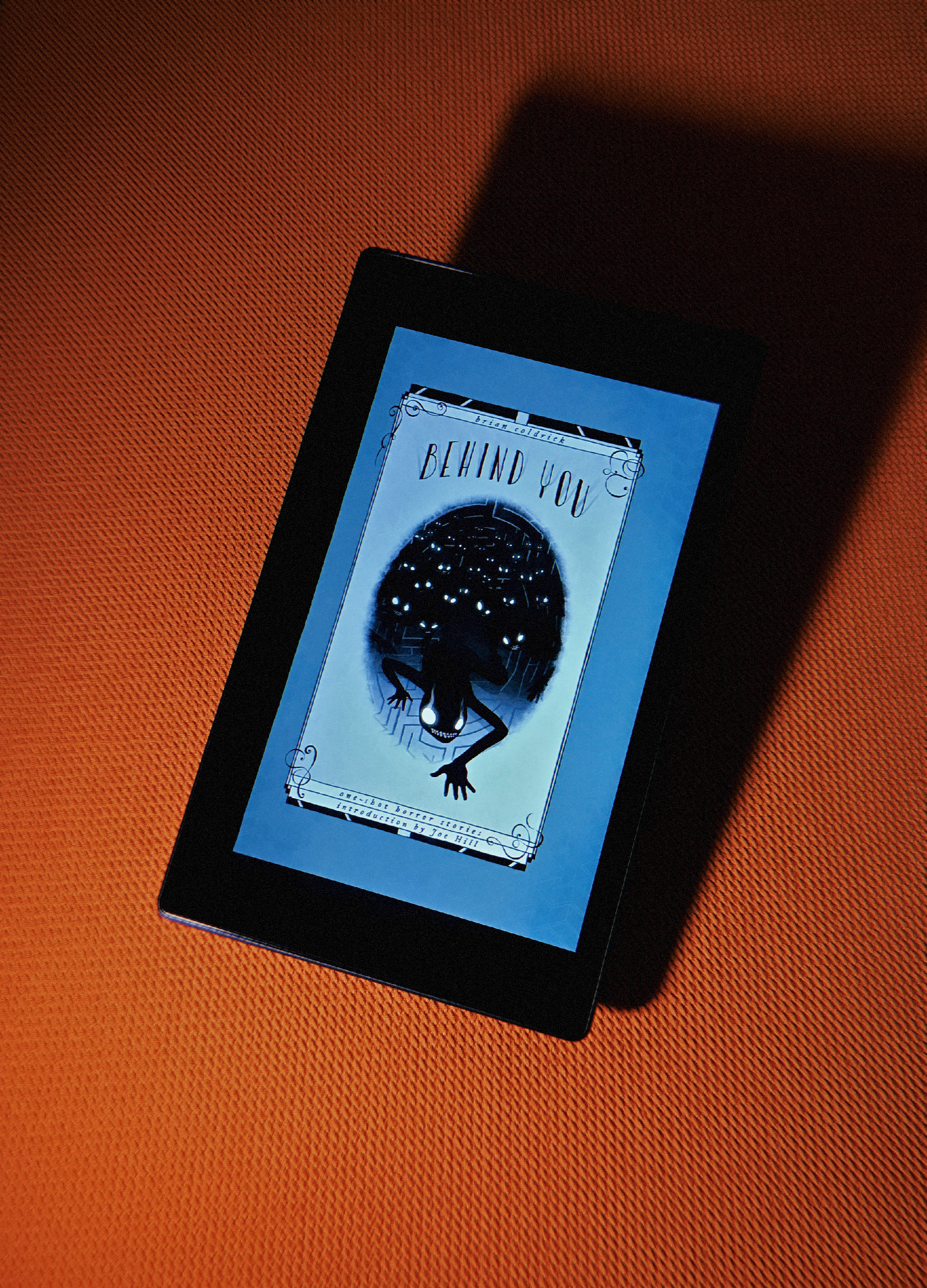
Behind You is basically artist Brian Coldrick going, “New Yorker cartoons but make ‘em spooky.” Single illustrations accompanied by a short piece of text and can range from the morbidly amusing to the downright unsettling. Coldrick has been at it for a while (I remember when his work was being shared around Tumblr a few years back) and has, according to Joe Hill’s introduction, “refined and purified the entire idea of Horror into a single, vital idea,” which, you know, coming from Stephen King’s progeny is high praise indeed. As far as I can tell, the series is still going, and this volume collects just a select handful of these creepy cartoons.⠀
⠀
The illustrations are, of course, the centerpiece, but the short text preceding them do a lot in terms of mood-setting and suggestion. They act almost as prompts: descriptive enough to tell at least part of a story, but simplistic and vague enough to let your mind entertain (or, depending on your disposition, torment) itself by thinking up the myriad of ways the scenes could play out. It’s almost as if you are the co-writer of this peculiar collection, which is an aspect I really enjoyed.⠀
⠀
The series is very much an online thing, however, and you’ll definitely get more from it if you have more than a passing knowledge of internet culture as a lot of the images here draw from content cultivated from memes and creepypastas (Slender Men, naturally, are abound). A lot of the images online are subtly animated, too, which add to the tone, and that element is obviously lost here in this static form.⠀
⠀
Behind You is a quick, fun Hallowe’en read, and you are sure to find an image that lingers in the back of your mind, especially if you read this alone in the small hours of the night. But I’m just assuming here because I definitely did not do that.
 WELCOME TO DEAD HOUSE by R.L. Stine
Welcome to Dead House follows siblings Amanda and Josh as their family moves to the small, quiet town of Dark Falls (subtlety was never Stine’s specialty), to live in an old house their father has inherited from a previously unknown relative. In no time at all Amanda starts to experience weird things: she keeps seeing strange kids around the house, and hears mysterious giggling and whispering coming from her room at night. She’s soon convinced their new place is haunted, which her family thinks it’s only anxiety brought about by the move. But there’s also the fact that her usually easygoing dog gets agitated around the house, and seems to mistrust every single person they meet in town….⠀
⠀
No Hallowe’en is complete for me without Goosebumps. I’ve been slowly making my way through them for the last couple of years, having never read the books when I was kid. This was my first time reading Welcome to Dead House, the first book of the series, an it is an auspicious beginning at that. It’s certainly darker than most other Goosebumps book I’ve read thus far, which never really strayed too far from relatively innocuous territory, whereas Dead House goes for that PG rating from the get-go. We are, after all, promptly treated to a sequence featuring a mostly skeletonized family, complete with bits of flesh still dangling from their bones. It’s a surprisingly gruesome book, all things considered, especially towards the end, which genuinely caught me by surprise. Stine is definitely not afraid to go hard. I was a fearful, finicky child and probably wouldn’t have enjoyed this kind of thing back then, but my present adult self certainly appreciates it. It’s very much a Goosebumps book at its heart, however, which means despite the macabre coating it’s still goofy and fun and a little schlocky.
The narrative itself does feel more streamlined when compared to later books in the series, where the stories tend to be a bit looser and meandering. But mostly I like how it seems like Stine had the structure (the skeleton, as it were) pretty much all worked out since the start of the series, chapter-ending cliffhangers and all. Goosebumps, after all, almost wasn’t even series, since it didn’t really sell until kids started getting a hold of them in school book fairs and went on to spread them around through word of mouth, causing a wave that would keep Goosebumps afloat through most of the nineties. Talk about coming up with such a winning formula from the outset.
 AUTUMNCROW by Cameron Chaney
An old man laments the loss of an old flame when he hears the siren song of the sea. A widow builds a jack-o’-lantern effigy for her dead husband in the hopes of seeing him one more time. A strained relationship between siblings has uncanny, burning consequences; while all the way across town a lonesome boy makes friends with graveyard ghouls. There are faces in the forest and visitants from space; whispers in the wind and chattering in the cornfields. There’s something in the soil of the valley, folks say, that attracts all manner of curious folk and odd happenings to it like a magnet. The locals long accepted the quirks of their community and stand by it, but they still offer up a warning to visitors: tread carefully — there are monsters here. ⠀
⠀
Welcome to Autumncrow, Cameron Chaney’s first collection of short stories that is nothing if not an absolute treat. It’s also pretty much the perfect read to cap off the spooky season. Do not be tricked by the cover and the catchline like I was, though — I went in expecting only a quirky compilation of Hallowe’en-themed tales, and while we certainly do get a taste of that with some of the selections, most of these fictional offerings are rather straight up, honest-to-goodness horror stories, with all that entails. Chaney explores different aspects of the genre with evident glee, while simultaneously running the reader through the gamut of emotions: joy and melancholy; delight and dread; playfulness and solemnity — often all at once, and often all in the same story.
Taken as a whole, however, Autumncrow is also essentially an examination of grief and loneliness. Most of the stories feature protagonists who are, in some way, looking to belong — to some place or to other people or to themselves. “Follow me in,” is a refrain that’s repeated throughout the collection, by various people and entities (and perhaps by the town itself). Some characters heed this call willingly, others are a bit more hesitant, some are even forced — but all of them can’t help but feel the alluring pull of the valley.⠀
⠀
Which brings us to the setting: Autumncrow may not be the Halloweentown I expected it to be, but it is undeniably a far more interesting place. Chaney wisely plays it vague with the history of the place, leaving a lot to the reader’s imagination while still offering up enough particulars to make the town feel lived-in and, despite the paranormal phenomena, real. And like every real place, it is depicted as being sometimes dangerous, sometimes beautiful, sometimes just simply… there — but always, always alive. I would love to read more stories in this setting. Autumncrow Valley is the very same October Country Bradbury so fervently celebrated. ⠀
⠀
I was highly impressed by this collection. It’s well worth the read.



 ricardo reading