
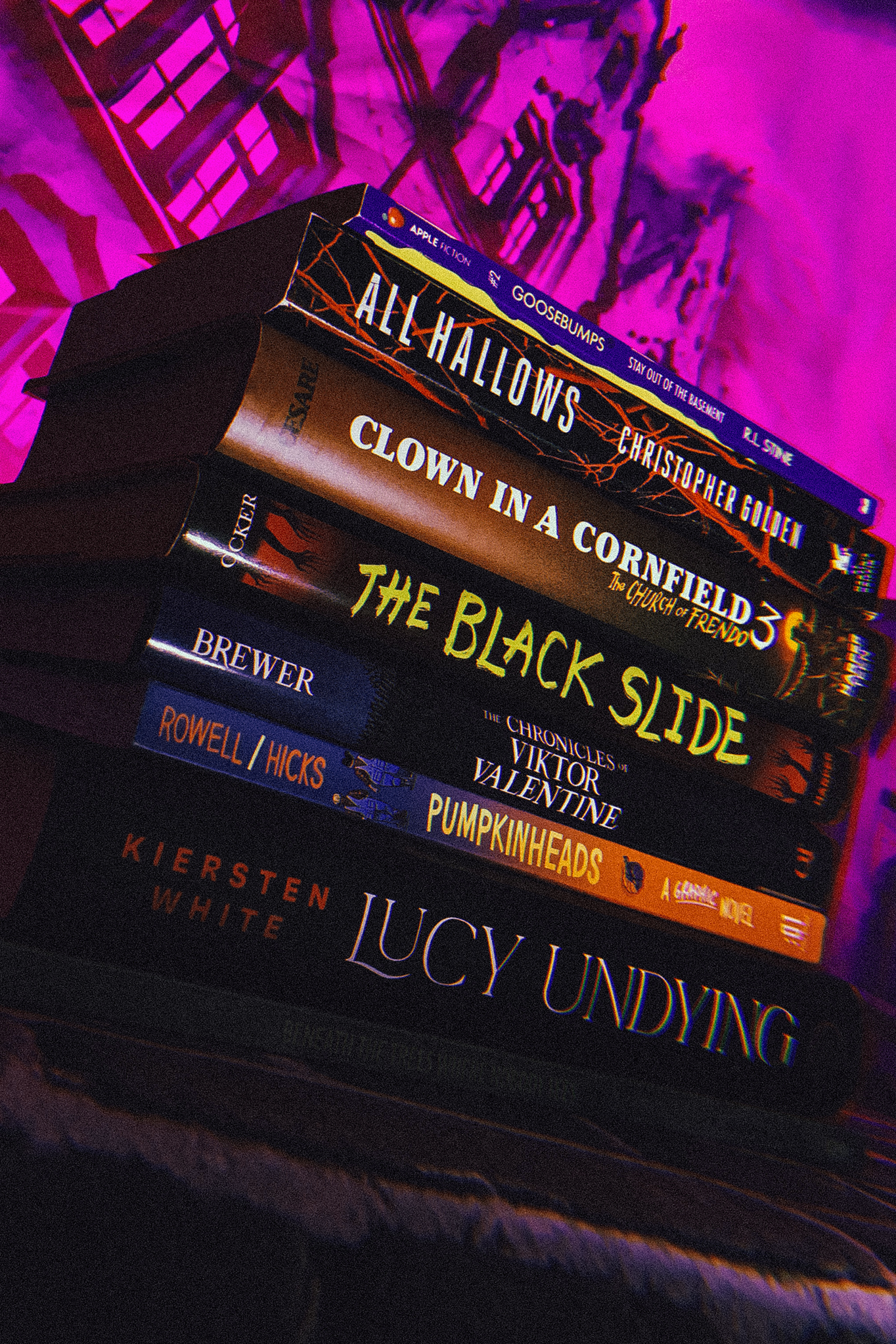
Hello. You know the books I read during the month of October because I did an individual review for every single one of them. Like a madman. But I also managed to read a bunch of short stories throughout the month, and I want to talk about them, too. So here we are. (Also it gives me an excuse to post a picture of a very satisfying pile of books. My gloriously garish Hallowe’en display.)




The books, in case you missed them:
Beneath the Trees Where Nobody Lives by Patrick Horvath. Wonderful!
The Chronicles of Viktor Valentine by Z Brewer. Fine!
Clown in a Cornfield 3: The Church of Frendo by Adam Cesare. Disappointing!
The Black Slide by J.W. Ocker. Amazing!
Lucy Undying by Kiersten White. Glorious!
Stay Out of the Basement by R.L. Stine. Fun!
All Hallows by Christopher Golden. Great!
The short stories:
“Parthenogenesis” / “Wait for Night” by Stephen Graham Jones. Would you believe that these are the only things I’ve read by Jones? Neither can I. Really need to get on that. Anyway, “Parthenogenesis” was a fun story with a super creepy atmosphere, but I felt like the ending was a bit of a cop-out. “Wait for Night” was just a simple and super rad vampire tale.
“A Stranger Knocks” by Tananarive Due. Didn’t realize this was a vampire story when I first picked it up, but I do love a serendipitous theme. Similar to the Jones situation, this is the first story I’ve read by Tananarive Due. Definitely need to pick up more of her stuff because this was excellent.
“The Tell-Tale Heart” by Edgar Allan Poe. My shameful secret that would surely get my goth card revoked if it ever got out is that I’ve barely read any of Poe’s actual work. “The Raven,” sure, the odd story here and there—but, like with most artists I admire, I’m far more interested in their cult of personality first and their work second. It’s something I’ve been gradually realizing is a serious disservice to said artists, so I’m working on fixing that. Anyway—this was brilliant, obviously. I read it in a collection called Darkness There, a Kindle in Motion affair that I’ve had on my tablet for years. It’s a neat concept, and features some wonderful art by M.S. Gorley, whose work—and name—evokes Edward Gorey’s (another cult of personality from my personal canon).
“Lantern Jack” by Christopher Fowler. More of a monologue than a proper short story—but it’s a damn good monologue, which made it a delight to read. Very cool, very clever, very macabre. Very into it. Read from The Mammoth Book of Halloween Stories.
“Everybody Is in the Place” by Emma J. Gibson. Some great atmosphere here, but I found the writing style seriously grating. There’s this constant repetition of words that I guess is supposed to evoke some sort of whimsicality (“We’re running, running, running!”) but it only comes across as awkward and annoying, particularly when it’s done so often in such a limited amount of space.
“A Forest, or A Tree” by Tegan Moore. Impeccable and creepy atmosphere throughout, along with some good character work. It’s too bad that it’s all undermined by an abrupt, hasty ending. As is the case with a lot of Tor.com Originals, this felt too much like the opening of a novel, rather than the closing chapter of one.
“The V*mpire” by P H Lee. This is a short story about Tumblr, of all things. It’s also a story about identity and community. And it’s a story about vampires. It should be a mess, by all accounts, but this was a surprisingly intense and impactful piece. Of course, it probably affected me more because Tumblr was such an integral, formative part of my 20s. I was too old to be part of the social circles depicted here, but I was certainly aware of them and can say that, for better or worse, their representation here is entirely accurate—from the compassion right down to the toxicity. This is also a story about how easily predators can exploit the openness of these often vulnerable communities by appropriating their particular language for their own malicious means. The vampires in this story may be fictional bloodsuckers, but that doesn’t make them any less real.
“Bone Fire” by Storm Constantine. Another one from The Mammoth Book of Halloween Stories. My notes for this story read, “A fae and dusky little story. This very much felt like what I imagine a huge bonfire on Samhain must have felt like.” I have absolutely no idea what that means, but let’s go with it.
(I should note that I often write my notes immediately after I finish reading a story, so they are very much a first impression kind of thing. It also means that they are almost always nonsense. Alas.)
“The Folding Man” by Joe R. Lansdale. A truly outlandish mix between an odd urban legend and, like, The Terminator. Simple, straightforward, and at times seriously savage story. I was super into it. Read from The Mammoth Book of Halloween Stories.
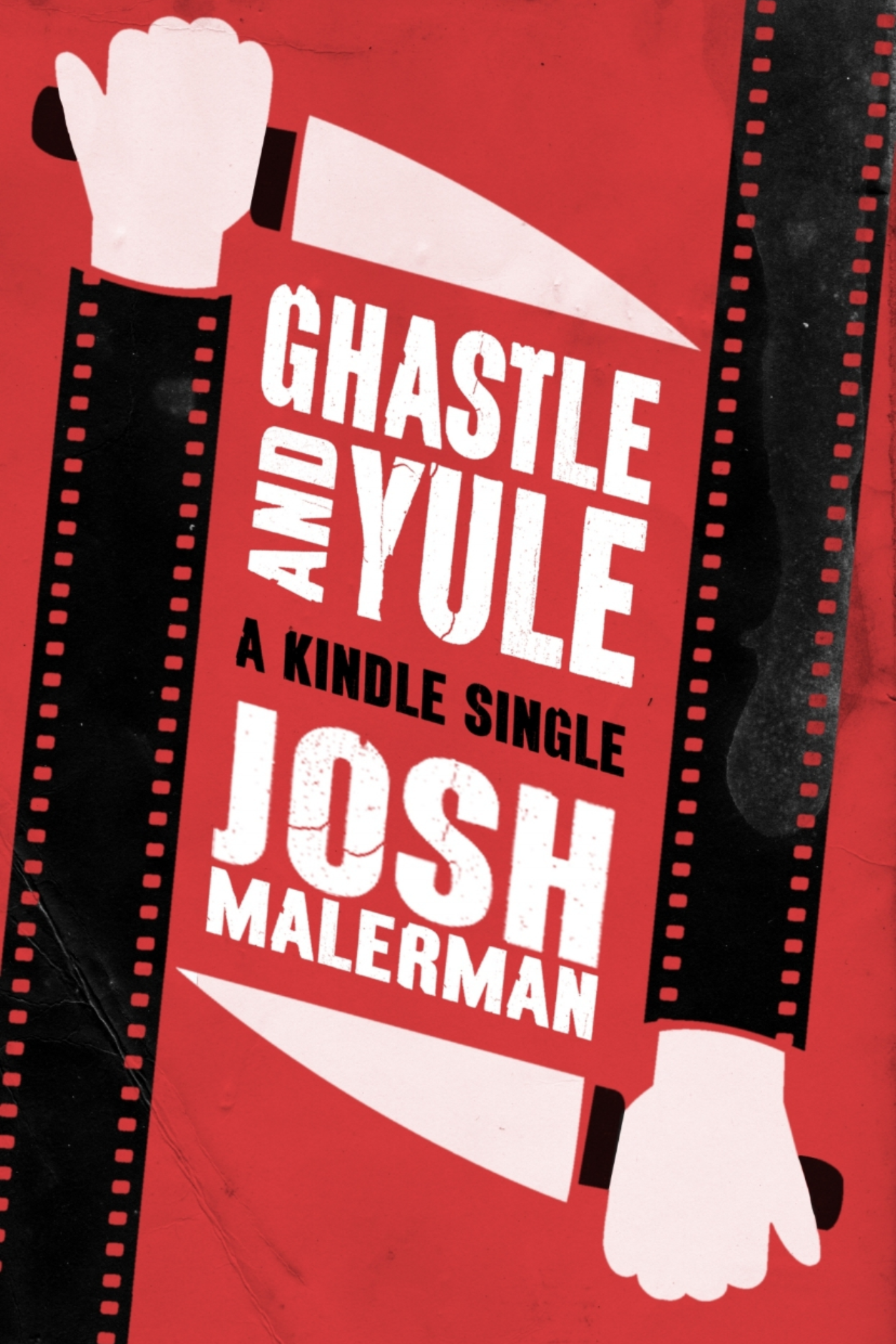
“Ghastle and Yule” by Josh Malerman. Despite its name, this was not a creepy Christmas story as I originally expected. Instead, it’s a tale about two rival horror filmmakers and their obsessions with both their craft and with one another. I enjoyed it a lot. The writing does leave a lot to be desired, at times—there’s more than a fair share of clunky, awkwardly phrased sentences—but the story itself is fascinating enough that I can easily forgive those shortcomings. I’ve always loved stories about film productions, particularly of the Old Hollywood and Mid-Century eras. This skews heavily towards the latter half of the fifties and early sixties, but it hit all the right notes for me. I was particularly impressed with Malerman’s world-building, which is so thorough and convincing that I found myself Googling the names of the characters and some of the film titles to see if they were real. Intriguing, morbid, and a lot of fun.
“The Ultimate Halloween Party App” by Lisa Morton. This one has a great and pretty terrifying premise, but it ultimately didn’t do much for me. The world-building felt cobbled together from interesting but half-formed ideas that never really meshed well. The ending, in particular, felt like a huge non-sequitur—as if the author got bored with her own story. Very baffling. Read from The Mammoth Book of Halloween Stories.
And finally, one book I did not do an individual review for, because I’ve written about it more than enough times:
Pumpkinheads by Rainbow Rowell, Faith Erin Hicks. A seasonal staple, obviously. I used to pick this one up at the very beginning of October but have since realized that it’s actually the perfect transitional read, being set on the last day of the month and all about endings and new beginnings. It literally concludes with the characters talking about taking up seasonal jobs during the holidays. Which brings me, once again, to ask Rowell and Hicks for a Christmas sequel to this beautiful book. Please. I beg. I implore.
And that’s another Hallowe’en season come and gone. I hope you all had a good one. I did, despite feeling at times as if I was forcing it a bit too much. (Really, is there anything more horrific than Life getting in the way of your enjoyment of frivolous things? I submit that there is not.) But in the end, I watched some fun movies, read some damn fine stories—even wrote one of my own—and I can’t ask for anything more than that.

 ricardo reading