
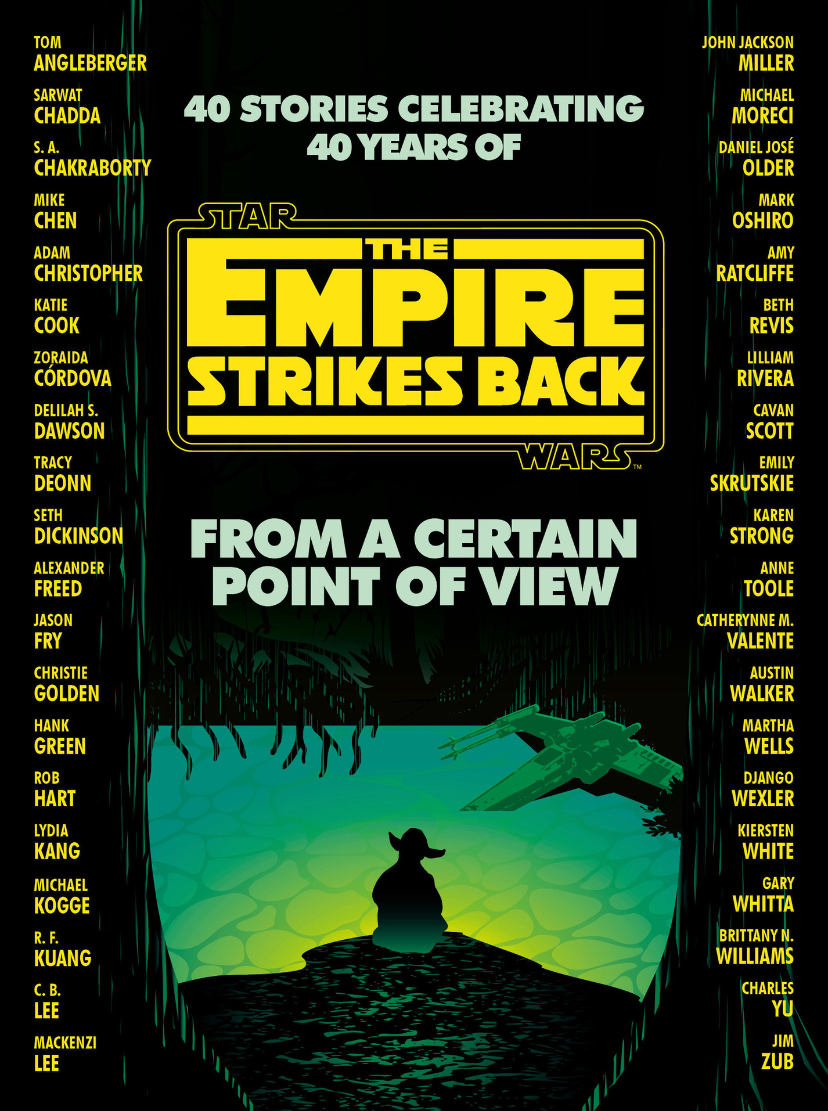
 The first volume of From a Certain Point of View was a surprise to be sure, but a welcome one. The Force Awakens had, well, awakened a long-dormant excitement for Star Wars within, pushing me down a nostalgic-tinged rabbit hole that led me to things like Star Wars Rebels (which still stands as my favorite piece of new SW media) and, eventually, inevitably, to the books. Up to that point in the aftermath of the Disney acquisition most of the stories had to do, naturally, with the new sequel trilogy of films, broadening the narrative and developing certain key characters. Occasionally some of the books dropped dealt with characters and events from bygone eras, but for the most part the expanded universe focused on the current. And then From a Certain Point of View suddenly arrived, an anthology featuring a wide array of writers telling the stories of dozens of peripheral characters from the film that started it all. It’s an idea that perfectly embodies this franchise’s most charming, playful notion: that everyone has a tale that needs to be told; that everyone has an important role to play in this far-away galaxy.
I ate it all up. The collection somehow managed to satisfy my nostalgic yen while also injecting some much needed, much welcomed fresh ideas to this familiar universe: from boasting a more diverse cast of characters (people of color! a touch of queer representation!) to playing with styles and genres. There was a lot of emphasis on lighthearted humor, of course, but a lot of the stories also packed quite the emotional punch. It was a wild ride, and definitely one of my favorite reads the year it came out. It made me hope they would continue with the concept, giving the rest of the films the same treatment. And so when this volume telling the story of The Empire Strikes Back was announced I was nothing if not thrilled.
Which just makes it all the more the shame that From a Certain Point of View: The Empire Strikes Back mostly disappointed me. It still boasts a broad battalion of authors — many of whom have written works I’ve enjoyed in the past — who do an admirable job with the material given while also continuing to ramp up the diversity aspect established in the first volume. Really, the ingredients that made me love the previous collection are all here, it’s just that, somehow, the recipe doesn’t particularly work with the story Empire ultimately told.
It makes sense. The first film introduced us to a vast cast of characters, giving the stories a wider area in which to play and let loose. In contrast, Empire’s story is smaller in scale and much more personal, concentrating less on the galaxy at large and more on the trials and tribulations of our protagonists. This leaves the authors of this collection to either focus on a scattering of minor characters or create new ones whole cloth. In any other context this would be a freeing conceit; here, though, it just ends up making the collection feel helter-skelter. Add to that the fact that quite a few of the stories are irreverent in nature, focusing on the humorous, slightly ridiculous side of the saga, eschewing the poignancy found in much of the first volume in favor of knowing winks at the audience. And while you will never find me stating that camp has no place in the Star Wars universe (it’s been there from the start, etched into its genetic makeup), I do think that, much like with the Force, there needs to be a balance.
In the spirit of said balance, I want to make note of the stories that did end up leaving a big impression on me, of which there were a handful:
Django Wexler’s “Amara Kel’s Rules for TIE Pilot Survival (Probably)” and Mackenzi Lee’s “There Is Always Another” feature the sort of clever cheek that does work for me, where humor is used to ground all these fanciful figures. The opening line in Lee’s story in particular will stand as one of the funniest in all of Star Wars.
I had hoped that dying would be enough to untangle me from the Skywalker’s family issues.
— Obi-Wan Kenobi’s Force ghost in “There Is Always Another” by Mackenzi Lee
Jim Zub’s “The First Lesson” and Lydia Kang’s “Right-Hand Man” in contrast, delve deep into the pathos of some of these mythical characters, and they were the stories I feel actually added some more substance to the story being told in the film. ⠀
And finally, Austin Walker’s “No Time for Poetry” and Alexander Freed’s “The Man Who Built Cloud City” both tell the type of story I currently enjoy the most in this universe, narratives which — much like my other two favorites, The Mandalorian and Rebels — manage to perfectly blend that mix of earnestness and enthusiasm that made Star Wars so damn precious and exceptional in the first place.
Perhaps it’s not the end at all. Perhaps it’s merely the darkest moment of a triumphant tale — when all is presumed lost, so that victory can be sweeter.
— Yathros Condorius in “The Man Who Built Cloud City” by Alexander Freed
I’ve mentioned it before but it bears repeating: disappointment is as much an integral part of being a Star Wars fan as the feeling of delight. And if there is anything to living in this post-Disney supersaturated world is that, for the foreseeable future at least, we can be certain there will soon be something else to anticipate, anyway.

 ricardo reading