
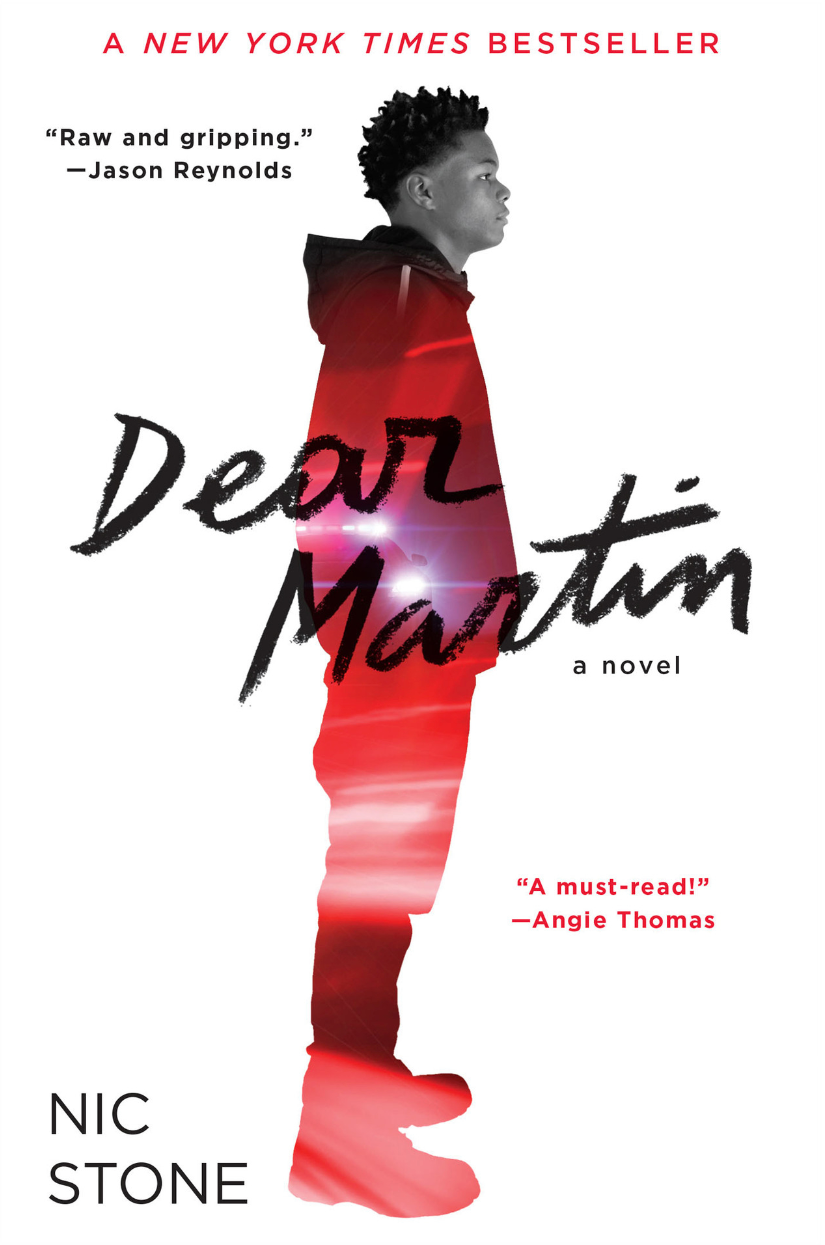
 So while Nic Stone’s first foray into the world of middle grade fiction left me feeling somewhat underwhelmed, I enjoyed aspects of it enough to leave me feeling like giving another of her books a shot. And wow am I glad I did. ⠀
⠀
Dear Martin is Nic Stone’s first published work, and where the writing in Clean Getaway feels stilted and hesitant, here it flows with a smooth, confident swagger. Which makes for a curious dichotomy: the prose is eminently readable, but the topics discussed are heavy, all too real and sometimes hard to read. But it’s a balance that Stone strikes splendidly.⠀⠀
⠀
Dear Martin follows Justyce McAllister, a brilliant student at an exclusive and privileged private school, whose life, at the start of the story, consists of excelling at school in order to get into the Ivy League, and trying to figure out a tumultuous relationship with his on-again/off-again/on-again girlfriend. Until one night, when trying to stop said girlfriend from driving home drunk, he is harassed by a racist cop who predictably assumes the worst. The experience leaves him shaken, enough that he starts to become increasingly aware of just how much he is judged by the color of his skin. ⠀
⠀
Justyce doesn’t know how to deal with this, so he starts a project with the goal of emulating Martin Luther King, Jr. in a series of letters that soon become the outlet for his fear and frustration. A project that comes to a tragic, screeching halt when he and his best friend are involved in a shooting, the fallout of which puts Justyce in the cross-hairs of the media and the general public, who insist on degrading and demeaning him.⠀
⠀
Nic Stone has written a heartbreakingly real and painfully relevant novel about the plague of systematized racism and how it continually, relentlessly tears down and dismantles Black youths. Justyce feels all too real, as a young Black man who has to work twice as hard as everybody else in order to stand on the same stage as his more privileged colleagues; as a less-than-perfect teenager just trying to figure out the trials and tribulations of adolescence, which is hard enough without the prejudice of others; as just this kid who just wants, like Martin, to face a world that never, ever lets up with all the grace and dignity of a king and just do good.⠀
⠀
The cover for my copy features a blurb by Angie Thomas, which is appropriate since this book explores the same theme as her excellent debut The Hate U Give. But whereas that book presents a more idealized conclusion of a community coming together to fight injustice, Dear Martin is, I think, a bit more realistic in its ambiguity — which just adds another layer of tragedy to the story. The ending of Dear Martin caught me off-guard, since it felt to me like there was more to the story. But there’s no neat resolution to be found here, no uplifting ending wrapped up in a bow. It ends like real-life situations often do: with uncertainty. We don’t know what’s going to happen to Justyce any more than he does. But Stone reminds us that, like Martin, we can hope, and we can dream. And maybe one day we’ll find our way towards justice.
Category: 2020
GHOST by Jason Reynolds
 Castle Crenshaw — who goes by Ghost — has been running for most of his life. At least ever since his father’s gun went off. It was pointed in the general direction of Ghost and his mother, and, like in all track races, the shot was a signal to start running. His father went to jail for it. They went back to a home that stopped feeling like home (they sleep in the living room, near the front door, just in case something else happens and they need to run again). And Ghost feels as if he never stopped. Only this restlessness he has felt inside has no real outlet, and it bubbles up, bursting outwards at times of stress and conflict. He lashes out, and gets in trouble for it often.⠀
⠀
And then one day, taking the usual long way back to his house, he stops to watch a group of kids his age during a track meet. He scoffs at the notion that people have to work at running, which comes so naturally to him. So he decides to show them up by beating their most promising and arrogant stars in an impromptu race. The coach is impressed and asks him to join, which Ghost, with some reluctance, eventually does.⠀
⠀
The feeling of running, Reynolds has said, is of your body going through trauma, as it fights against exhaustion and suffocation. Running is about feeling like you are about to die, and getting used to that sensation. And running is about breaking through, and overcoming that feeling.⠀
⠀
Running is also, in Reynolds’ hands, an exceedingly useful metaphor — not only for the particular issues that Ghost faces, but for life in general. Because what is life if not just a series of races you have to break through in order to breathe again? For Ghost, running is initially a means of escape, useful only when he wants to put as much distance between his problems and himself. He doesn’t find the act itself uncomfortable — his life is suffocating enough, after all, what is a little sprinting compared to the day to day? “Running ain’t nothing I ever had to practice,” he boasts at the beginning. “It’s just something I knew how to do.” It’s only after he joins the team and it becomes an increasingly important aspect of his life that he properly begins to feel this suffocation, as he starts to come to terms with the heavy things he’s been carrying inside — this scream, as he calls it — for most of his life.⠀
⠀
Ghost is about a lot of things, but it is mainly about dealing and living with trauma. There is a talk Jason Reynolds gave where he told the story about a childhood friend who, decades after the fact, recognized that he had been traumatized at a young age, and that he just went through life as if these feelings were normal, only to later realize that they were not supposed to be, and how surprised he was at this understanding. No one, you see, made him aware of the fact. It’s a particularly cruel problem, and one we can only address by paying attention to the people around us. This is what Reynolds’ work does for his audience — his books are all about being seen. In this novel, seeing one another is what Ghost’s teammates do, as they accept him as one of their own. It’s what his mother does, who, despite demanding job, studies at night in order to give them a better future. It’s what Mr. Charles, the elderly owner of the local store shop does every time Ghost pays his store a visit and they fall into an established, familiar — and familial — routine. And most importantly, it’s what his track coach does, seeing in Ghost some of the same struggles he faced growing up. The kind of struggles that makes you want to disappear, like a ghost, and run away, instead of being present, the burning in your chest a reminder that you are still alive and able to run free. Ghost may not entirely realize the full extent of his trauma, but he is smart enough to know when the people around him care for and want the best for him, which in turn, of course, makes him want to be better for them. “You can’t run away from who you are,” the Coach tells him at one point, “but what you can do is run toward who you want to be.”⠀
⠀
The novel ends with a different kind of shot that makes Ghost run. Only this time, instead of running away, you are certain and hopeful that he’s running free, breaking through the struggle, towards a better future.⠀
⠀
Jason Reynolds has written yet another lyrical and poetic book chockfull of meaning, and which helps us see these kids in a better and more understanding light. I loved reading it.
CLEAN GETAWAY by Nic Stone
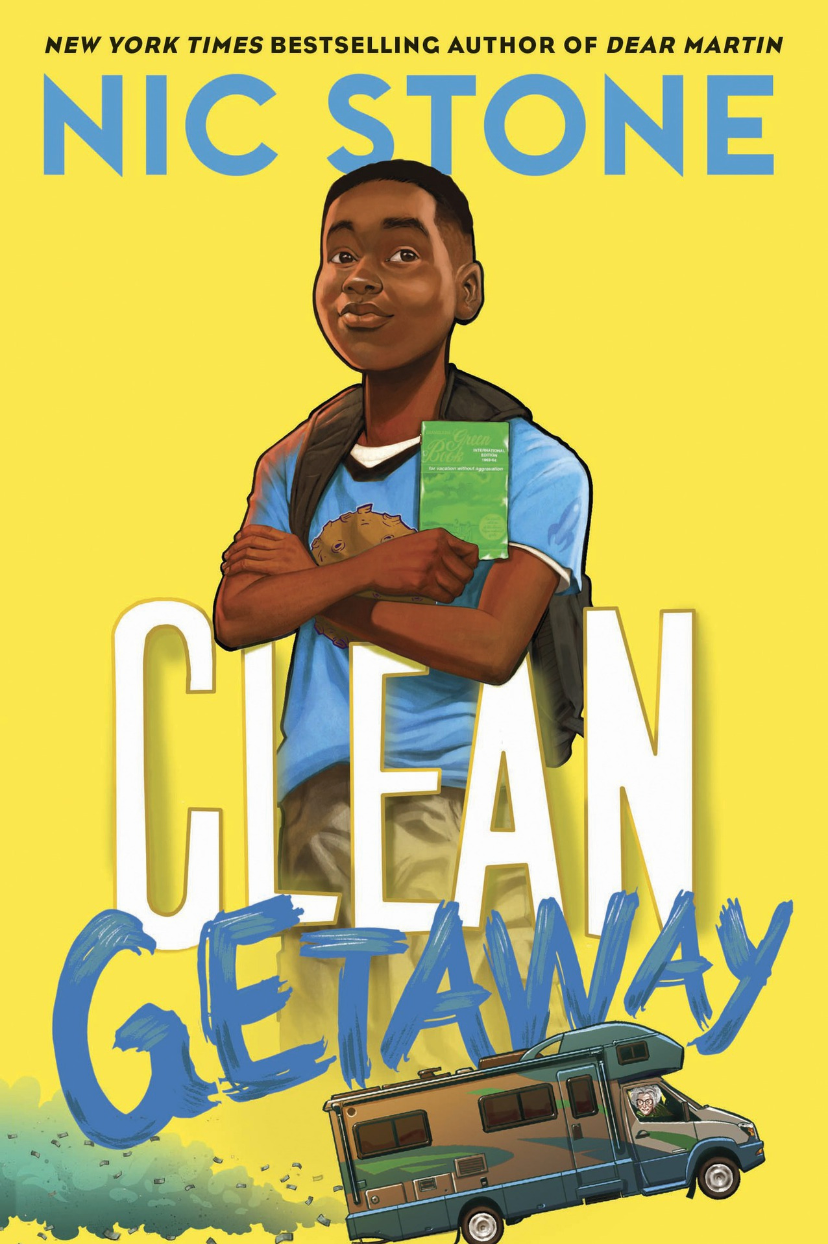 Clean Getaway tells the story of William “Scoob” Lamar, an eleven year old Black kid, and G’ma, his white grandmother, and the road trip they embark upon across the American South. A trip for which they have their own motives: Scoob leaves behind serious punishment following a school suspension, and a severe father whose severity only increases after said suspension. He just wants to get away from it all and clear his head. G’ma wants to show Scoob places where history has been made — but also to deal with some unfinished business from her past. Issues that cause her to act increasingly erratic and shady.⠀
⠀
It’s a great premise (love me a road trip tale), but I felt the story just didn’t live up to its potential. Scoob at times felt like a real and modern kid, dealing with things while still trying to keep his cool, while at others he seemed too unrealistically passive. His G’ma’s strange behavior introduces a mystery in the first few chapters of the novel, which is an effective way to hook a reader — having the main character endlessly wonder about said mystery without actually doing anything about it for the remainder of the books is an equally effective way of losing one. But it’s the character of G’ma that I found the most problematic. She started off fine — quirky and goofy and lovable. As someone who grew up watching The Golden Girls, I love seeing elderly women as main characters. As the story went on, however, and her eccentricity increased, she just made me uncomfortable. Which I get is sort of the point. Scoob grows more and more suspicious of his grandmother, and we are supposed to be on the same page as him. Only there’s no real actual payoff to this. ⠀
⠀
Look — this is a story that deals largely with racism. A theme that is explored almost exclusively through the eyes of this old white woman, who lived through the civil rights movement as the wife of a black man, in a place where this sort of relationship was still largely frowned upon. There’s a wealth of subjects to explore, and Stone does an admirable job with what she does delve into. But then we finally learn the secret she’s been keeping and how it affected her family, and it’s quite a bombshell. You’re left wondering how the rest of her family will deal with the shock waves. But it’s all ultimately brushed off, the aftermath left to the margins of the story. G’ma is given a simple send-off, and the consequences of her actions are never properly explored. Which is a shame, really. G’ma is a character that is deeply loved and idolized (and idealized) by her grandson and her son. Nic Stone wrote that this was a novel about finding out your heroes are human — flawed to a fault. It just would have been nice to actually see what that entailed right on the page. Clean getaway, indeed.
⠀
But while the overall concept didn’t work for me, there were still aspects I really enjoyed: this is a fast, fun read, full of interesting facts that I suspect will lead young readers down interesting, awareness-increasing rabbit holes, and that can only be a good thing. Nic Stone’s prose has a few missteps (it sometimes falls into that common and condescending trap of writing simple for a simple audience), but it is mostly clear and sharp. This is the writer’s first foray into middle-grade fiction, though, and I’m sure she can only get better from here.
THE DEEP by Rivers Solomon
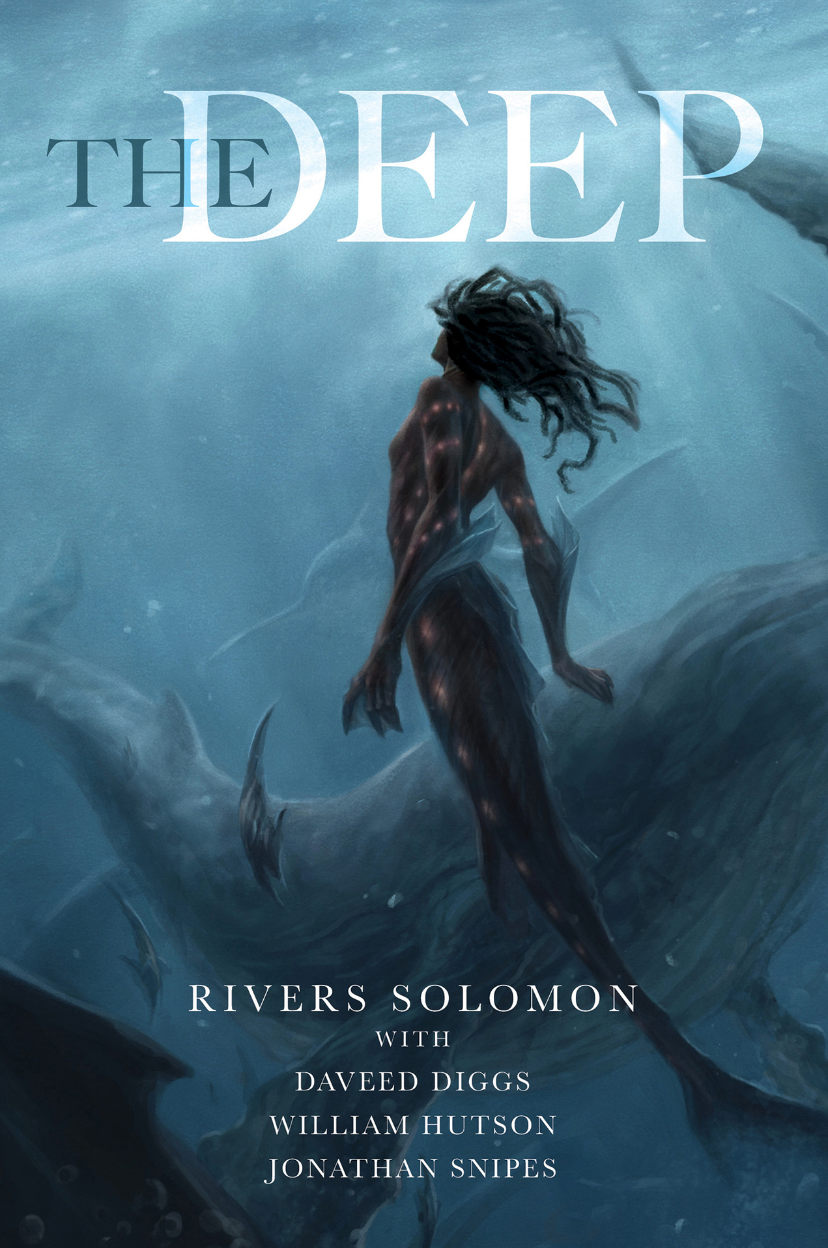 The Deep is a novella written by Rivers Solomon that is based on the Hugo-nominated song of the same name by the experimental hip hop group clipping. Their song was itself based on the afrofuturist mythology that Drexciya, an electronic duo from Detroit, created for their compilations.⠀
⠀
Which is the sort of fascinating thing you learn when you read the acknowledgements. ⠀
⠀
The Deep is about a lot of things. On its surface, though, it is about the wajinru, a mermaid-like people who have great power over the ocean but little memory. For good reason — they are a people descended from the pregnant African women who were thrown overboard during the slave trade, their unborn babies granted new aquatic life by the ocean. Theirs is a history of pain and strife. In order to thrive despite the suffering, it was decided long ago that one of their people — a Historian — should carry the burden of their history and collected memory. A responsibility that falls on Yetu, our delicate and long-suffering main character.⠀
⠀
To be a Historian means experiencing every single memory as if it was your own. Yetu however, has a fragile constitution, and so this task, this weight she carries that has stripped her of any individual identity, is killing her.⠀
⠀
So it is no surprise to us when, during an annual ceremony where the wajinru gather in order to receive the memories of their past for a brief time, time enough to satisfy a deep thirst for their own history, that Yetu, free from remembering, runs away. ⠀
⠀
What do we do with the trauma that we’ve inherited?⠀
⠀
In the acknowledgements, clipping. describes the nested style of development this particular story has gone through as a game of Telephone, the original message relayed over and over, each time a bit more different. Drixceya’s songs were largely wordless, and so they started to tell a story through their song titles — a provocative and engaging concept. clipping. took inspiration from it, added considerable amounts of verbiage, and sang a story about a world being destroyed by global warming, and about a people who rise up and exact revenge on the ones who caused it. Rivers Solomon heard the song, and decided to bring it back down to a more personal level, writing a story about a people, and their relationship to history. Their relationship to stories.⠀
⠀
Stories (and what is history if not a bunch of stories we tell about ourselves?) act much like a game of Telephone. They are passed down, and thus they survive, but their shape changes as they get interpreted differently by every individual. In The Deep we are told that the role of Historian is one handed down from generation to generation, and we are presented with three different bearers of the title: Zoti, Basha, and Yetu. And through them we get three interpretations of history. To Zoti, the first Historian, it is vital to the continued survival of their people. To Basha, it is a call to action, past hurts fueling a righteous rage at present injustice. And to Yetu, it is simply a burden, too deep and heavy to carry on her own.⠀
⠀
What do we do with the trauma that we’ve inherited? It’s the central question Yetu struggles with during her journey of self-discovery. It also happens to be the question millions of people whose history has been steeped in anguish and adversity. Do we let it define us? Do we ignore it? Do we drown in it? Or do we use it to build a better, more just civilization?
Yetu finds her answer in The Deep. She shares it with her people. And she shares it with you, too.
Rivers Solomon has written a compelling, poetic, and thought-provoking story, with lyrical prose that enriches clipping.’s exhilarating song, with an imagination that expands Drexciya’s foundational mythos. It’ll stay with you. You will remember it.
NEW KID by Jerry Craft
 New Kid follows Jordan Banks, a twelve-year-old kid about to start the seventh grade. A budding cartoonist, Jordan wishes for nothing more than to go to art school, but his parents, wishing him to have better opportunities than they had, decide to send him to a more affluent school. A prestigious private school, to be exact. A school where Jordan is one of the few kids of color. Being the new kid is hard enough, but this, in addition to coming from a more modest background than most of his peers, means dealing with a bunch of unwelcome challenges — not least of which being general ignorance and racism — as Jordan just tries to go about his days, trying to figure things out.⠀
⠀
I really enjoyed New Kid. While I was not a huge fan of the artwork itself, the story and the writing definitely won me over. I really loved — and admired — how it maintained a light and fun tone while also exploring some heavy themes. It’s a deceptively casual book in this way. There are depictions of class difference, of code-switching as a person of color, of casual racism and microaggressions, of privilege and lack thereof — and they are all portrayed in the same easy-going manner. Underneath this layer of mellow, though, there’s a current of frustration and exasperation that runs all the way through, which makes this casual story lose none of its pointed poignancy. Because being a person of color in this world sometimes means keeping your cool even during the most uncomfortable of times, even if you’re a child.⠀
⠀
But these weighty subjects don’t make up the whole of the story. Just as they don’t make up the lives of the kids who have to deal with them. One of the central themes in New Kid has to do with Jordan’s frustration with books about kids of color being extremely limited in scope: books about white kids can be about anything and still expected to be relatable; books about Black kids can only be about Serious Issues and are expected to be read only by Black kids. Books about white kids can be fun; books about Black kids have to be severe and gritty. Jordan thinks this is extremely unfair nonsense. Because, yes, while kids like him may have to deal with more complicated situations than most others — at the end of the day they’re also… just kids. Normal and goofy and beautiful and awkward and nerdy and clever kids who would love to do nothing more than just live and have fun and be happy and to see other kids like them doing likewise. This doesn’t mean that books about Serious Issues are not important, only that reality is far more complex, and stories about said reality should reflect it accordingly. Because representation is important. This is what Craft does with New Kid, and does it elegantly. It’s my favorite aspect of this story.
⠀
It’s also a book that’s just funny and clever, which is what instantly hooks you. Jordan and his group of friends are instantly likeable and relatable. The art, as I said, wasn’t my favorite, but Craft’s storytelling is clear and concise, and the book has great pacing because of it.⠀
⠀
It’s another one of those books I wish I could give to my younger self. Which is something I often find myself saying about a lot of the kid’s books I’ve recently read. I think that’s an inevitable thought to have, though, as someone who spent their childhood reading nothing much at all, after reading a particularly great children’s book. There’s a sense of deprivation — of having missed out — and wanting to go back and fix that. It’s bittersweet, but in a positive way, you know?⠀
⠀
I digress. ⠀
⠀
New Kid is a fine book. It deserved to win the Newbery Medal, and I can’t wait to see what that means for the future of graphic novels and children’s fiction in general.
DAISY JONES & THE SIX by Taylor Jenkins Reid
 This is the second Taylor Jenkins Reid book that I’ve read and this is the second time Taylor Jenkins Reid book that has left me emotionally drained.
I am turning into quite the fan.⠀
I like her direct style of writing: spear-like prose designed to immediately pierce the most hardened, cynical shell. I like her melodramatic and convoluted plots that immediately hook you and absolutely refuse to let go. Mostly, though, I love her characters: lively and alluring; broken and nuanced; intractable and infuriating; infinitely interesting and impossibly human. Jenkins Reid writes great unsavory characters, the sort of people you may not want to be friendly with, but with whom you are perfectly willing to spend an evening that will be certain to be full of great stories and conversation — and maybe even greater mischief. Daisy Jones definitely joins the ranks of Jenkins Reid’s own Evelyn Hugo as one of the best, most fully realized characters I have read in a long time.⠀
Daisy Jones & The Six is the story of an old school rock and roll band comprised of these same sort of explosive characters. The book is presented as an oral history, chronicling the meteoric rise and fall of the band during the seventies. ⠀
A couple of years ago I read — and loved — Meet Me in the Bathroom, Lizzy Goodman’s oral history of the rock and roll revival in New York City during the early aughts. I was reminded of the book a lot while reading Daisy Jones & The Six, as it essentially tells the same sort of story, only on a much more smaller, more personal scale. So I really enjoyed the format, which helps the story feel even more immediate and intimate. And, if you have an affinity for writing natural dialogue it’s a format that can serve a fictional narrative well. Jenkins Reid writes great dialogue, and does a great and admirable job with the form, faltering only with one crucial misstep.
The fact that this is a story told by multiple characters inherently means that it is a story told by unreliable narrators. This is a standard trope, tried and tested since time immemorial, and here it makes for great moments of humor (the numerous ways the characters contradict each other over the most trivial things), as well as moments of heartbreaking pathos (the myriad of misunderstandings and missed opportunities and things left unsaid). It also proves to be the book’s greatest weakness, however, giving rise to a twist that feels deeply unnecessary and that sadly casts a cheap light on the story as a whole. It’s a tragic ending in the sense that it is very weak, wasting much the momentum and the emotional build-up (of which there is a lot).⠀
But it’s the characters who are the saving grace of any story, and it’s no different here. Daisy Jones and Billy Dunne are the obvious standouts of course — like the stage’s spotlights, the focus of the book is entirely on them — but it’s the characters standing just outside the limelight that have stayed with me the most. Karen Karen, keyboardist of The Six, with a tenacity and courage that reside behind an infectious personality. Daisy Jones is an acutely feminist book, and Karen’s story is the most representative of this conceit. I cared about her perhaps more than any other character. And with Camilla Dunne, Jenkins Reid has written a character of such complexity and charm who in a lot of ways outshines Daisy Jones. Everyone in the book talks at length about how easy it is to fall in love with Daisy. I spent the majority of the book wondering how everyone wasn’t just falling head-over-heels for Camilla. But that is, of course, Camilla’s story.⠀
Poor ending aside, Daisy Jones & The Six is an emotional roller coaster ride. And you can’t help but feel invested in the lives of this memorable, messy, and charismatic cast of characters. Can’t help but be enthralled by the theatrical and deeply romantic story Taylor Jenkins Reid is telling. And, most importantly, you can’t help but be mesmerized by the inimitable Daisy Jones & The Six.⠀
○○○
So this was the first time in a good while that I listened to an audiobook! I kept reading about how stellar this production was and I just had to give it a go. It was great! It’s a brilliant cast and they did a marvelous job. It was nice hearing Benjamin Bratt’s voice again, and Pablo Schreiber continues to deliver consistently great performances — he’s such an underrated actor. Jennifer Beals as Daisy is just a dream, her voice having the right amount of rough smokiness to sell the fact that, yeah, I can totally hear an aging rock star in those vocal chords. My only issue with it is that it is advertised as unabridged when it’s really not. I read along with an ebook copy (I just don’t have the attention span for audiobooks), and there were several bits that were just skipped. Not enough to really affect the story, mind, but enough that it was noticeable. So why say it’s unabridged at all?
But I really enjoyed the experience, overall. I’m a fairly fast reader and get through books in a manner of days — this one took me a while, but I liked taking my time with a story, and sitting with it a little longer. It definitely helped. (I listened to it on normal speed, by the way. Genuinely don’t understand how anyone can listen to anything faster than that and not be distracted by the chipmunk voice effect it produces. You guys are nuts.)
COME TUMBLING DOWN by Seanan McGuire
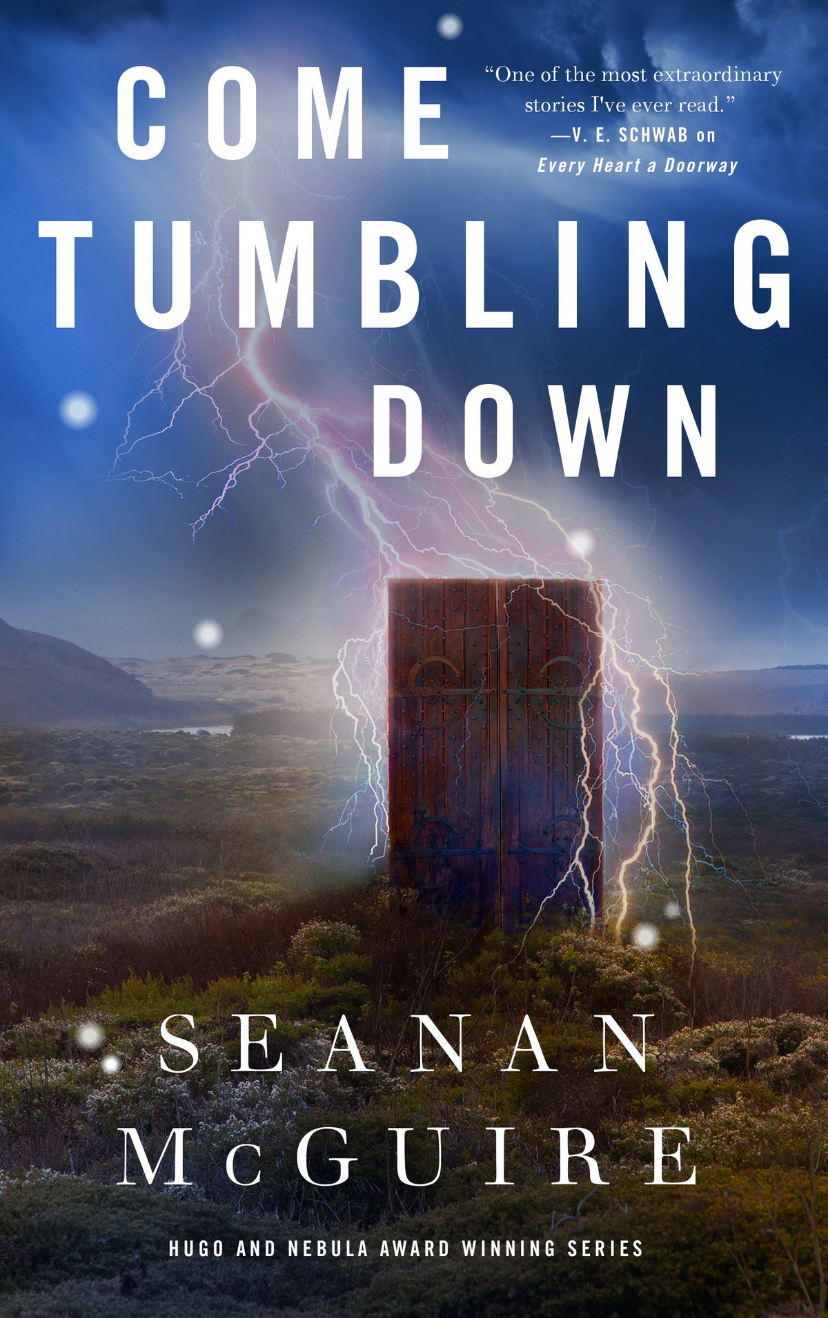 I’ve been singing the praises of Seanan McGuire’s Wayward Children series ever since reading the first book, Every Heart a Doorway, when it came out in 2016. Every following year since then, McGuire has released a new installment, and I’ve dutifully read every single one, thinking they were each a gift.
It’s a series that I love. That much is true. But it’s also been a series that has been, in retrospect, somewhat hit or miss for me, too.
This was very much a miss for me. Which is disappointing, seeing as how this book follows Jack and Jill, two of my favorite characters in this series (for my money, Down Among the Stick and Bones, the second installment of the series, and the first that was centered around them, is probably the best out of the whole bunch).
(Some spoilers for the previous books ahead.)
Come Tumbling Down, the fifth entry in the series, picks up where Every Heart a Doorway left Jack and Jill: with murderous Jill dead at the hands of Jack, who drags her body back to their dark world of the Moors, where she can easily be resurrected. Jack is successful in this regard, only to have her body snatched by her sister, who means to use it — much to Jack’s complete chagrin — for Dark Purposes that put the whole of the Moors in cataclysmal danger. After a personal tragedy, Jack is compelled to reach out to her former fellow students at Eleanor West’s School for Wayward Children and ask for their help in restoring the balance her world demands and that she so desperately craves.
The premise is intriguing enough, but the payoff ultimately falls short. There are exciting, nerve-wracking stakes that are introduced very suddenly… only to be waved away just as quickly. The writing is still characteristically gorgeous (McGuire’s writing has always been the star of the Wayward Children books, after all), but a lot the dialogue feels stilted and forced this time around, the characterization clunky and awkward. There’s just a lot here that just didn’t click for me, in the end.
The slightly spotty portrayal was the main thing that felt out of place for me for me, the most egregious example being Sumi, a character who veers totally into tropeish underestimated-ingenue-who-is-also-profound-and-wise territory. How every other character in this story keep thinking of her as just a simple-minded Cloudcuckoolander when her every other declaration is nothing but pure perspicacity is beyond me. It’s frustrating.
If I’m being fastidious, it’s only because you are always a little harder on your favorites.⠀
The way McGuire releases these books is that she alternates between time periods: one book will follow the School story in the present, and the other will follow one of their characters in the past, as they stumble upon their doors and find out what lies on the other side. I’ve enjoyed the latter books a lot more. They may come from the more traditional portal fantasy mold, but that is a form of storytelling of which I am fond. And besides, knowing what the future holds for many of these characters adds a bittersweet angle to these stories, which I also appreciate. I like my fairy tales fairly full of melodrama.
Do I still think these books are a gift? Yes, of course I do. As previously mentioned: the preeminent star of these stories is Seanan McGuire’s own prose, which is as ethereal and rhapsodic as ever, and which makes her less than stellar work shine far brighter than most
You are always a little harder on your favorites, but every Wayward book is still an endowment from the world on the other side of the door, and is appreciated as such.
SEVERANCE by Ling Ma
Severance 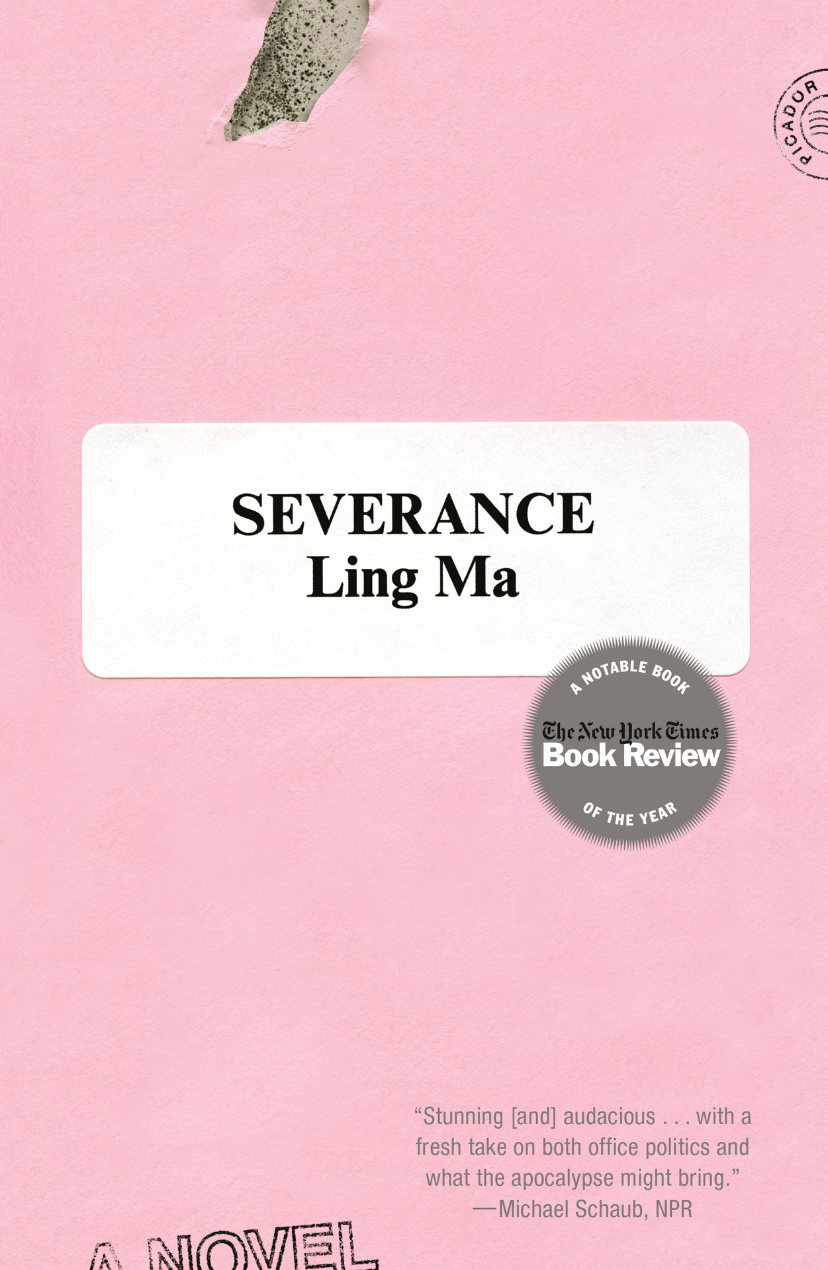 follows Candace Chen as she tries to live in a world that has fallen after a slow plague renders those infected into, essentially, the walking dead.⠀
⠀
This isn’t a zombie book however. At least not traditionally. Ling Ma’s zombies — called fevered here — are not brainless monsters, looking to devour flesh. No, the fevered here are simply humans, cursed to the routine of their previous lives. The fevered do the dishes. The fevered scroll through their phones. The fevered drive and go to work and then they go home. And they do this over and over and over. Stuck on a loop, until their bodies give out.⠀
⠀
The fevered, you see, are just like us.⠀
⠀
With Severance, Ling Ma has written a scathing satire about modern life, office/hustle culture, and gross, unchecked capitalism, all without succumbing to the tired sort of lectures favored by all Boomers, e.g., “technology is bad fire is scary Thomas Edison was a witch.” Instead, Ma opts for the more realistic and nuanced approach of letting us know that, actually, we make our own apocalypses. That what we let into our lives, the habits and routines we choose for ourselves, can often spell out our damnation just as well as they do our salvation (or vice versa).
⠀
This theme is characterized in Candace, our flighty but practical and stubborn main character, whose life is essentially saved from the apocalypse by the dreary routine that also forced her to push her dreams and ambitions aside in exchange for safety and comfort. She keeps waking up and washing her face and going to work. Even after her co-workers abandon theirs job and the office building is emptied out. Even after New York turns, essentially, into a ghost town.⠀
⠀
Sometimes we make our own apocalypse. Often so that we can just live.⠀
⠀
Candace decides to leave, mostly because she locked herself out of the office. On her way out from New York, she meets and joins up with another group of survivors on their way to Chicago where the group’s leader — a pompous, pedantic, despot-in-the-making, because even after the world ends you cannot escape these dudebros — assures them there is a safe place he calls “the Facility.” There, he tells them, they can live in relative comfort and, hopefully, begin to rebuild civilization anew.⠀
⠀
Interspersed through the core narrative, are stories from Candace’s earlier life, up to and including tales of her parents, who immigrated to the US when she was just six years old, and the challenges they faced as the simply tried to live. Because this is an immigrant story as well, and how often they are seen as outsiders, even — and especially — when the outside world has crumbled and fallen. ⠀
⠀
Sometimes we make our own apocalypse. Sometimes, the apocalypse just happen to you.⠀
⠀
I didn’t expect Severance to connect with me as much as it did, although considering all the things we are currently going through in the world right now, and the fact that my generation as whole seems to be perpetually caught in a quarter-life crisis, that I would find relevance in a post-apocalyptic novel shouldn’t really be that surprising. ⠀
⠀
There’s a small category on my Goodreads called “zeitgeist fiction” where I collect stories I think encapsulate the general “feeling” of a particular era. There’s no clear and set definition, it’s entirely subjective (the Scott Pilgrim books are in there, for instance, as is Rona Jaffe’s The Best of Everything). Severance, with its surprising and poignant explorations of the immigrant experience, loneliness, nostalgia, and just modern 21st century life in general, was immediately added. I’m having a hard time thinking of any other recent book that captures the spirit of our current age so clearly and so cleverly.
THE SECRET COMMONWEALTH by Philip Pullman
 When the Book of Dust trilogy was still in its formative stage, whenever Philip Pullman was asked anything about it, one of the things he liked to say was that this new set of books could have well been called His Darker Materials, referring to it having much more serious, adult themes. He would say this in a joking sort of manner, however. Good old Uncle Philip.⠀
⠀
But Uncle Philip was not joking.⠀
⠀
La Belle Sauvage, the first volume of this “equal” trilogy, worked in two ways: first, as a gentle re-introduction into the world, then, later, as a jolt to the system. Pullman quickly abandons the familiar, and, much like the flood that takes place in the story, he brings forth a myriad of new elements into his world. And the world of Lyra’s Oxford, so welcoming at first, suddenly turns, yes, darker — but also infinitely weirder.⠀
⠀
And with The Secret Commonwealth, Pullman continues to subvert our expectations at every turn, fulling diving into the stranger, more psychedelic aspects of the world he has wrought.⠀
⠀
The Secret Commonwealth takes place twenty years after the events of La Belle Sauvage, and ten years after those in The Amber Spyglass, and we still follow Lyra, older but still familiar: as acerbic and headstrong as ever. But Pullman pulls the rug out from under us soon enough, and we realize that she has indeed changed in numerous ways. Where once she was a wild child, she’s now more serious and stoic. Eschewing “childish things,” she has taken to reading philosophical works that seem like this world’s version of Objectivism. This has created a distance between her and dæmon Pantalaimon, who thinks Lyra has lost her lust for life by “losing her imagination.” After a particularly nasty argument, Pan leaves Lyra, off to search for, one supposes, her innocence. This, along with some sinister forces intent on her capture, propels Lyra into a strange and terrible journey in search of a possibly mythical place where dæmons dwell without humans, in the hopes of reuniting with Pan. As she makes her way further East, we are treated with a handful of increasingly extraordinary vignettes that demonstrate the diverse ways humans and dæmons relate to one another.⠀
⠀
Pullman maintains this series is about the nature of Dust, but the relationships between dæmon and human is such a prominent them (which is carried on from La Belle Sauvage where villain Bonneville’s treatment of his own dæmon still haunts), that perhaps The Book of Dæmon would have been a more appropriate title.⠀
⠀
In a book full of strange happenings, turning Lyra into an enthusiast of a philosopher who is, for essentially, an Ayn Rand surrogate, is perhaps one of the strangest. Entire sections are devoted to Lyra and Pan having energetic and fascinating arguments about books and philosophy, the merits of imagination and the importance of rationalism. These scenes allow us to see the ever-growing disconnect between Lyra and her dæmon, but they are still slightly jarring and perplexing.
⠀
But if His Dark Materials is told through a more grounded, scientific sort of lens (dust equals dark matter), then The Book of Dust is Pullman looking at the world from the other, more mythical side of lens, where dust also equals… a portal to yet another realm, where fae things lie. The secret commonwealth of the title.⠀
⠀
This all lends the story a sort of metanarrative layer, one where Pullman seems to argue with his younger self, who perhaps held different views to the ones he holds now. It reads less like a argumentative debate, however, and than it does a sensible, reasonable discussion, wherein one tries try to figure out how to live with other, perhaps opposing worldviews. How they can enrich our perspective. How they can open up the secret commonwealth.⠀
⠀
As if to illustrate the point, the other half of this book consists of following Malcolm Polstead, our main character in La Belle Sauvage, now a professor and somewhat of a spy and man of action. His story follows him on a quest to find out more about a certain rose that may hold a connection to Dust, as well as his far more personal search for Lyra, and it reads like an honest-to-goodness ridiculous spy novel and it is a joy to read. These two stories may seem at odds with one another, but the balance each other well, and pushes us through a 600-page narrative like a speeding train.⠀
⠀
With The Book of Dust, Pullman has continually surprised me. I have absolute no idea where the story is going. And I can’t wait to find out.
RESISTANCE REBORN by Rebecca Roanhorse
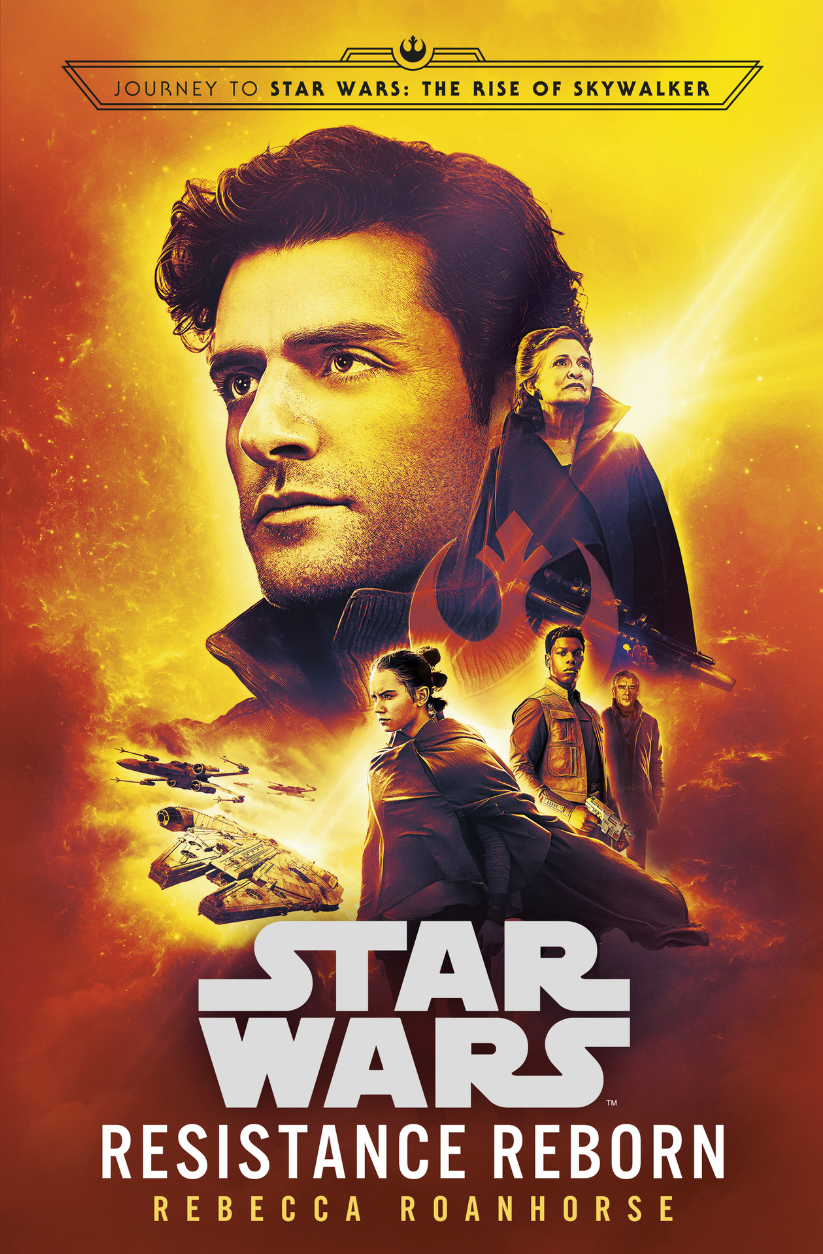 Well I certainly didn’t expect my first read of 2020 to be a Star Wars book. To be perfectly honest, after the underwhelming disappointment of The Rise of Skywalker and the emotional exertion of The Mandalorian finale, I was beginning to feel a little burned out on Star Wars. That feeling was still present when I started reading the first few chapters of this novel, and I began to get the notion that maybe this story, like the final Skywalker film, just wasn’t for me.⠀
⠀
But I kept up with the book, and was quickly proven wrong, as once the story well and truly kicks in it hits you like a jump to hyperspace.⠀
⠀
Resistance Reborn takes places just after The Last Jedi, and before The Rise of Skywalker, and tells the story of how the Resistance begins to rebuild their greatly diminished, and overwhelmed fleet. In the climax of The Last Jedi, the Resistance’s call for help goes unanswered, despite them knowing they have allies out there. The main narrative follows their investigations into what happened to these, and their efforts to seek out and recruit further sympathizers.⠀
⠀
Much has been said about this book being an Avengers-scale crossover, bringing in characters from different stories, across different media from the expanded universe — from the films, to comics, to even the video games — all coming together for a final stand. In the hands of any other writer this would have been an unwieldy task, but Roanhorse proves skillful enough to handle it with poise and panache. In Resistance Reborn, she has written a heist story, a thriller, and a political drama that never fails to be fun, and never, ever loses sight of the most important aspect of the whole Star Wars galaxy: its characters.⠀
⠀
Resistance Reborn boasts a huge cast of characters, but it is also mostly Poe’s tale, and I love Roanhorse’s characterization of him here. Outside of The Force Awakens and his comic book series, Poe is a character that Star Wars doesn’t really know what do with. In The Last Jedi and Rise of Skywalker, he’s reduced to an arrogant pilot who is constantly screwing things up in a spectacular fashion, redeems himself, but then fails to learn his lesson as he repeats the same mistakes further down the line. In TFA we were introduced to a character that was hotheaded yes, but also ceaselessly charming, loyal, and optimistic. This portrayal carried on in the books and the comics, but got cast aside as the final two films decided to have him be little more than a Han Solo stand-in. Which is boring and disappointing. Roanhorse also further develops his relationship with Finn, including a handful of scenes that are not only touching and thematically relevant, but also add fuel to the FinnPoe fire. (Literally the only ship I’ve wanted to see set sail. Alas.) ⠀
He just felt at a disadvantage around Rey. He still didn’t know her well and she clearly meant a lot to Finn, and Finn meant a lot to him, so Rey mattered.
(I mean.)
Unfortunately, Roanhorse doesn’t get to do a lot with Rey here, however. Her portrayal is fine and serviceable, but it’s also very minor. I assume this was because her story was being reserved for TRoS.⠀
⠀
The other characters are great and a lot of fun, with a decent amount of familiar faces returning (including a character that literally made me go “oh daaamn,” out loud). I want to make special mention of Shriv Suurgav, though, a character pulled in from the Battlefront II video game. He was new to me, as I’ve never played the game, but he quickly became a favorite. He serves mostly as comic relief here, but brought some pathos as well. I really loved his inclusion here.
⠀
Rebecca Roanhorse has, with a single book, become one of my favorite Star Wars author. For my credits I think she and Claudia Gray could easily carry this entire expanded universe by themselves, and what rich stories we would get.
 ricardo reading