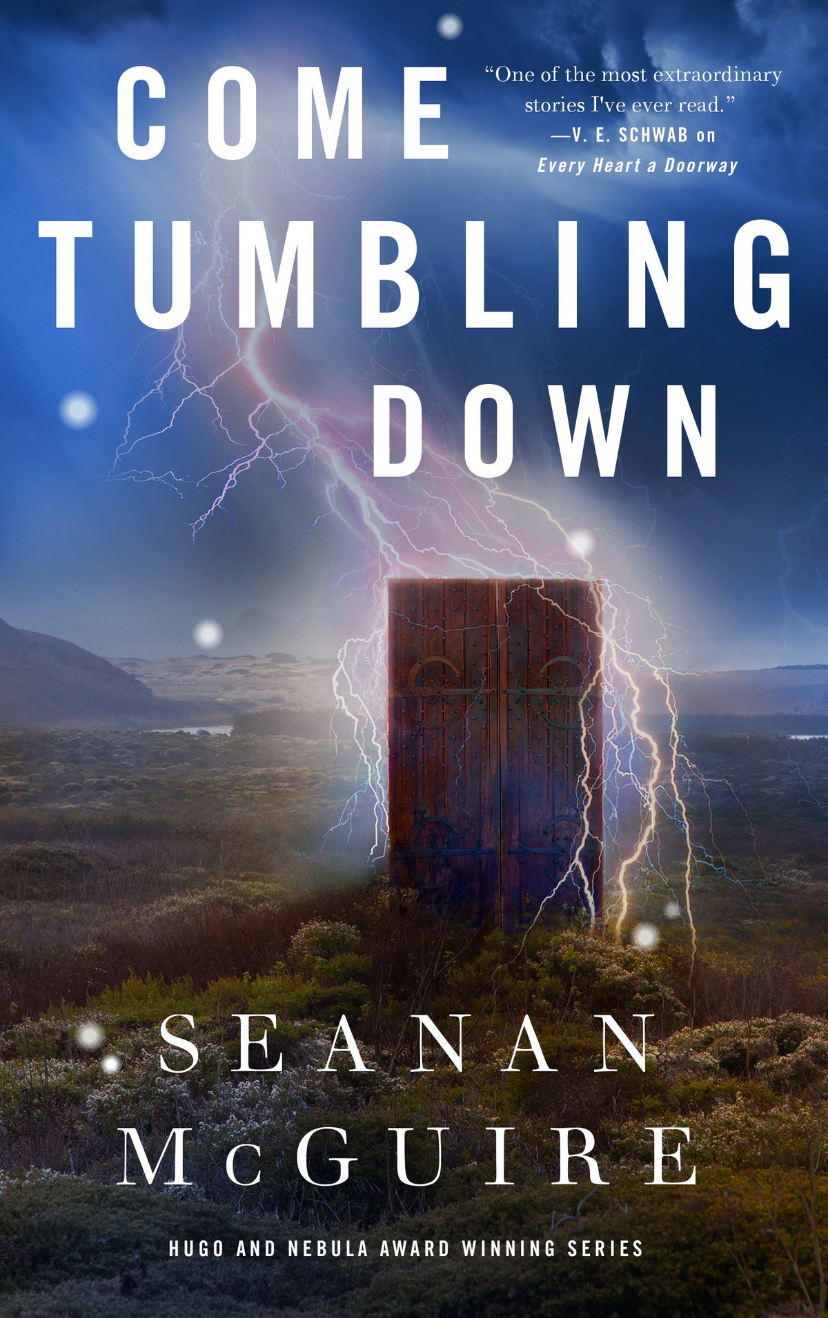
COME TUMBLING DOWN by Seanan McGuire

come-tumbling-down-by-seanan-mcguireI’ve been singing the praises of Seanan McGuire’s Wayward Children series ever since reading the first book, Every Heart a Doorway, when it came out in 2016. Every following year since then, McGuire has released a new installment, and I’ve dutifully read every single one, thinking they were each a gift.

It’s a series that I love. That much is true. But it’s also been a series that has been, in retrospect, somewhat hit or miss for me, too.

This was very much a miss for me. Which is disappointing, seeing as how this book follows Jack and Jill, two of my favorite characters in this series (for my money, Down Among the Stick and Bones, the second installment of the series, and the first that was centered around them, is probably the best out of the whole bunch).

(Some spoilers for the previous books ahead.)

Come Tumbling Down, the fifth entry in the series, picks up where Every Heart a Doorway left Jack and Jill: with murderous Jill dead at the hands of Jack, who drags her body back to their dark world of the Moors, where she can easily be resurrected. Jack is successful in this regard, only to have her body snatched by her sister, who means to use it — much to Jack’s complete chagrin — for Dark Purposes that put the whole of the Moors in cataclysmal danger. After a personal tragedy, Jack is compelled to reach out to her former fellow students at Eleanor West’s School for Wayward Children and ask for their help in restoring the balance her world demands and that she so desperately craves.

The premise is intriguing enough, but the payoff ultimately falls short. There are exciting, nerve-wracking stakes that are introduced very suddenly… only to be waved away just as quickly. The writing is still characteristically gorgeous (McGuire’s writing has always been the star of the Wayward Children books, after all), but a lot the dialogue feels stilted and forced this time around, the characterization clunky and awkward. There’s just a lot here that just didn’t click for me, in the end.

The slightly spotty portrayal was the main thing that felt out of place for me for me, the most egregious example being Sumi, a character who veers totally into tropeish underestimated-ingenue-who-is-also-profound-and-wise territory. How every other character in this story keep thinking of her as just a simple-minded Cloudcuckoolander when her every other declaration is nothing but pure perspicacity is beyond me. It’s frustrating.

If I’m being fastidious, it’s only because you are always a little harder on your favorites.⠀

The way McGuire releases these books is that she alternates between time periods: one book will follow the School story in the present, and the other will follow one of their characters in the past, as they stumble upon their doors and find out what lies on the other side. I’ve enjoyed the latter books a lot more. They may come from the more traditional portal fantasy mold, but that is a form of storytelling of which I am fond. And besides, knowing what the future holds for many of these characters adds a bittersweet angle to these stories, which I also appreciate. I like my fairy tales fairly full of melodrama.

Do I still think these books are a gift? Yes, of course I do. As previously mentioned: the preeminent star of these stories is Seanan McGuire’s own prose, which is as ethereal and rhapsodic as ever, and which makes her less than stellar work shine far brighter than most

You are always a little harder on your favorites, but every Wayward book is still an endowment from the world on the other side of the door, and is appreciated as such.

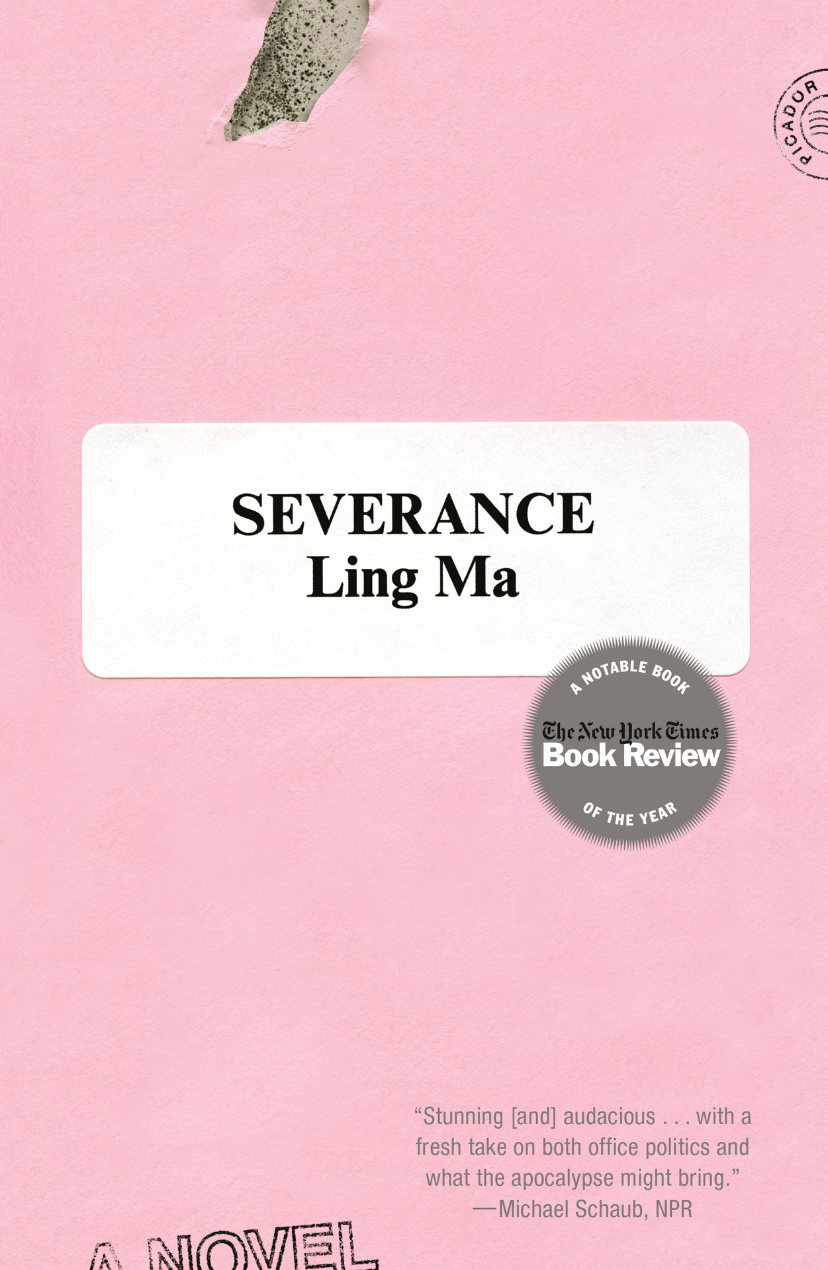
SEVERANCE by Ling Ma

Severance severance-by-ling-mafollows Candace Chen as she tries to live in a world that has fallen after a slow plague renders those infected into, essentially, the walking dead.⠀

This isn’t a zombie book however. At least not traditionally. Ling Ma’s zombies — called fevered here — are not brainless monsters, looking to devour flesh. No, the fevered here are simply humans, cursed to the routine of their previous lives. The fevered do the dishes. The fevered scroll through their phones. The fevered drive and go to work and then they go home. And they do this over and over and over. Stuck on a loop, until their bodies give out.⠀

The fevered, you see, are just like us.⠀

With Severance, Ling Ma has written a scathing satire about modern life, office/hustle culture, and gross, unchecked capitalism, all without succumbing to the tired sort of lectures favored by all Boomers, e.g., “technology is bad fire is scary Thomas Edison was a witch.” Instead, Ma opts for the more realistic and nuanced approach of letting us know that, actually, we make our own apocalypses. That what we let into our lives, the habits and routines we choose for ourselves, can often spell out our damnation just as well as they do our salvation (or vice versa).

This theme is characterized in Candace, our flighty but practical and stubborn main character, whose life is essentially saved from the apocalypse by the dreary routine that also forced her to push her dreams and ambitions aside in exchange for safety and comfort. She keeps waking up and washing her face and going to work. Even after her co-workers abandon theirs job and the office building is emptied out. Even after New York turns, essentially, into a ghost town.⠀

Sometimes we make our own apocalypse. Often so that we can just live.⠀

Candace decides to leave, mostly because she locked herself out of the office. On her way out from New York, she meets and joins up with another group of survivors on their way to Chicago where the group’s leader — a pompous, pedantic, despot-in-the-making, because even after the world ends you cannot escape these dudebros — assures them there is a safe place he calls “the Facility.” There, he tells them, they can live in relative comfort and, hopefully, begin to rebuild civilization anew.⠀

Interspersed through the core narrative, are stories from Candace’s earlier life, up to and including tales of her parents, who immigrated to the US when she was just six years old, and the challenges they faced as the simply tried to live. Because this is an immigrant story as well, and how often they are seen as outsiders, even — and especially — when the outside world has crumbled and fallen. ⠀

Sometimes we make our own apocalypse. Sometimes, the apocalypse just happen to you.⠀

I didn’t expect Severance to connect with me as much as it did, although considering all the things we are currently going through in the world right now, and the fact that my generation as whole seems to be perpetually caught in a quarter-life crisis, that I would find relevance in a post-apocalyptic novel shouldn’t really be that surprising. ⠀

There’s a small category on my Goodreads called “zeitgeist fiction” where I collect stories I think encapsulate the general “feeling” of a particular era. There’s no clear and set definition, it’s entirely subjective (the Scott Pilgrim books are in there, for instance, as is Rona Jaffe’s The Best of Everything). Severance, with its surprising and poignant explorations of the immigrant experience, loneliness, nostalgia, and just modern 21st century life in general, was immediately added. I’m having a hard time thinking of any other recent book that captures the spirit of our current age so clearly and so cleverly.

THE SECRET COMMONWEALTH by Philip Pullman

the-secret-commonwealth-by-philip-pullmanWhen the Book of Dust trilogy was still in its formative stage, whenever Philip Pullman was asked anything about it, one of the things he liked to say was that this new set of books could have well been called His Darker Materials, referring to it having much more serious, adult themes. He would say this in a joking sort of manner, however. Good old Uncle Philip.⠀

But Uncle Philip was not joking.⠀

La Belle Sauvage, the first volume of this “equal” trilogy, worked in two ways: first, as a gentle re-introduction into the world, then, later, as a jolt to the system. Pullman quickly abandons the familiar, and, much like the flood that takes place in the story, he brings forth a myriad of new elements into his world. And the world of Lyra’s Oxford, so welcoming at first, suddenly turns, yes, darker — but also infinitely weirder.⠀

And with The Secret Commonwealth, Pullman continues to subvert our expectations at every turn, fulling diving into the stranger, more psychedelic aspects of the world he has wrought.⠀

The Secret Commonwealth takes place twenty years after the events of La Belle Sauvage, and ten years after those in The Amber Spyglass, and we still follow Lyra, older but still familiar: as acerbic and headstrong as ever. But Pullman pulls the rug out from under us soon enough, and we realize that she has indeed changed in numerous ways. Where once she was a wild child, she’s now more serious and stoic. Eschewing “childish things,” she has taken to reading philosophical works that seem like this world’s version of Objectivism. This has created a distance between her and dæmon Pantalaimon, who thinks Lyra has lost her lust for life by “losing her imagination.” After a particularly nasty argument, Pan leaves Lyra, off to search for, one supposes, her innocence. This, along with some sinister forces intent on her capture, propels Lyra into a strange and terrible journey in search of a possibly mythical place where dæmons dwell without humans, in the hopes of reuniting with Pan. As she makes her way further East, we are treated with a handful of increasingly extraordinary vignettes that demonstrate the diverse ways humans and dæmons relate to one another.⠀

Pullman maintains this series is about the nature of Dust, but the relationships between dæmon and human is such a prominent them (which is carried on from La Belle Sauvage where villain Bonneville’s treatment of his own dæmon still haunts), that perhaps The Book of Dæmon would have been a more appropriate title.⠀

In a book full of strange happenings, turning Lyra into an enthusiast of a philosopher who is, for essentially, an Ayn Rand surrogate, is perhaps one of the strangest. Entire sections are devoted to Lyra and Pan having energetic and fascinating arguments about books and philosophy, the merits of imagination and the importance of rationalism. These scenes allow us to see the ever-growing disconnect between Lyra and her dæmon, but they are still slightly jarring and perplexing.

But if His Dark Materials is told through a more grounded, scientific sort of lens (dust equals dark matter), then The Book of Dust is Pullman looking at the world from the other, more mythical side of lens, where dust also equals… a portal to yet another realm, where fae things lie. The secret commonwealth of the title.⠀

This all lends the story a sort of metanarrative layer, one where Pullman seems to argue with his younger self, who perhaps held different views to the ones he holds now. It reads less like a argumentative debate, however, and than it does a sensible, reasonable discussion, wherein one tries try to figure out how to live with other, perhaps opposing worldviews. How they can enrich our perspective. How they can open up the secret commonwealth.⠀

As if to illustrate the point, the other half of this book consists of following Malcolm Polstead, our main character in La Belle Sauvage, now a professor and somewhat of a spy and man of action. His story follows him on a quest to find out more about a certain rose that may hold a connection to Dust, as well as his far more personal search for Lyra, and it reads like an honest-to-goodness ridiculous spy novel and it is a joy to read. These two stories may seem at odds with one another, but the balance each other well, and pushes us through a 600-page narrative like a speeding train.⠀

With The Book of Dust, Pullman has continually surprised me. I have absolute no idea where the story is going. And I can’t wait to find out.

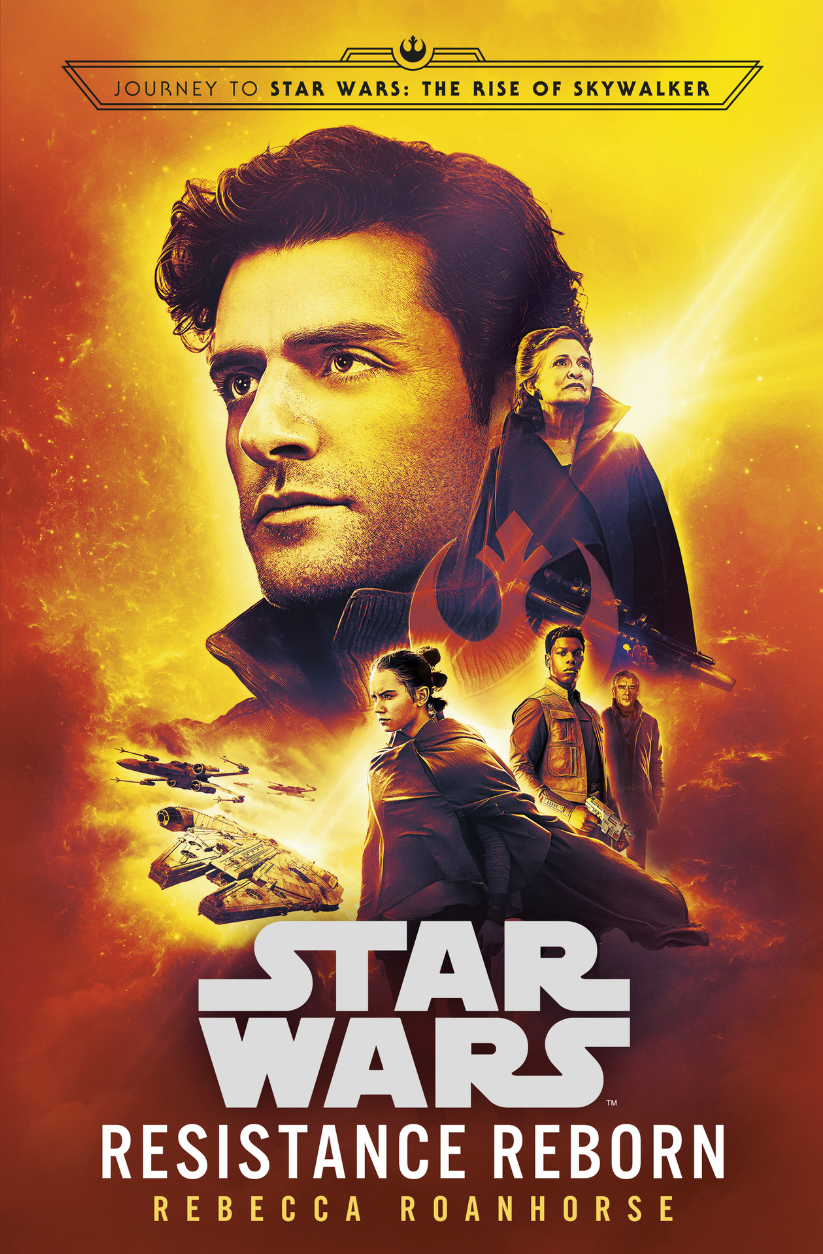
RESISTANCE REBORN by Rebecca Roanhorse

resistance-reborn-by-rebecca-roanhorseWell I certainly didn’t expect my first read of 2020 to be a Star Wars book. To be perfectly honest, after the underwhelming disappointment of The Rise of Skywalker and the emotional exertion of The Mandalorian finale, I was beginning to feel a little burned out on Star Wars. That feeling was still present when I started reading the first few chapters of this novel, and I began to get the notion that maybe this story, like the final Skywalker film, just wasn’t for me.⠀

But I kept up with the book, and was quickly proven wrong, as once the story well and truly kicks in it hits you like a jump to hyperspace.⠀

Resistance Reborn takes places just after The Last Jedi, and before The Rise of Skywalker, and tells the story of how the Resistance begins to rebuild their greatly diminished, and overwhelmed fleet. In the climax of The Last Jedi, the Resistance’s call for help goes unanswered, despite them knowing they have allies out there. The main narrative follows their investigations into what happened to these, and their efforts to seek out and recruit further sympathizers.⠀

Much has been said about this book being an Avengers-scale crossover, bringing in characters from different stories, across different media from the expanded universe — from the films, to comics, to even the video games — all coming together for a final stand. In the hands of any other writer this would have been an unwieldy task, but Roanhorse proves skillful enough to handle it with poise and panache. In Resistance Reborn, she has written a heist story, a thriller, and a political drama that never fails to be fun, and never, ever loses sight of the most important aspect of the whole Star Wars galaxy: its characters.⠀

Resistance Reborn boasts a huge cast of characters, but it is also mostly Poe’s tale, and I love Roanhorse’s characterization of him here. Outside of The Force Awakens and his comic book series, Poe is a character that Star Wars doesn’t really know what do with. In The Last Jedi and Rise of Skywalker, he’s reduced to an arrogant pilot who is constantly screwing things up in a spectacular fashion, redeems himself, but then fails to learn his lesson as he repeats the same mistakes further down the line. In TFA we were introduced to a character that was hotheaded yes, but also ceaselessly charming, loyal, and optimistic. This portrayal carried on in the books and the comics, but got cast aside as the final two films decided to have him be little more than a Han Solo stand-in. Which is boring and disappointing. Roanhorse also further develops his relationship with Finn, including a handful of scenes that are not only touching and thematically relevant, but also add fuel to the FinnPoe fire. (Literally the only ship I’ve wanted to see set sail. Alas.) ⠀

He just felt at a disadvantage around Rey. He still didn’t know her well and she clearly meant a lot to Finn, and Finn meant a lot to him, so Rey mattered.

(I mean.)

Unfortunately, Roanhorse doesn’t get to do a lot with Rey here, however. Her portrayal is fine and serviceable, but it’s also very minor. I assume this was because her story was being reserved for TRoS.⠀

The other characters are great and a lot of fun, with a decent amount of familiar faces returning (including a character that literally made me go “oh daaamn,” out loud). I want to make special mention of Shriv Suurgav, though, a character pulled in from the Battlefront II video game. He was new to me, as I’ve never played the game, but he quickly became a favorite. He serves mostly as comic relief here, but brought some pathos as well. I really loved his inclusion here.

Rebecca Roanhorse has, with a single book, become one of my favorite Star Wars author. For my credits I think she and Claudia Gray could easily carry this entire expanded universe by themselves, and what rich stories we would get.

THRAWN: TREASON by Timothy Zahn

thrawn---treason-by-timothy-zahnDecember is for Star Wars.⠀

I really enjoyed Zahn’s return to his iconic character in the first book of this series. Getting a story from the point of view of a character that essentially boils down to “Sherlock Holmes but uh even more alien” makes for some fun reading.⠀

I enjoyed the second entry, Alliances, a fair deal more. Telling that story in alternating chapters first with Thrawn and Vader and then with Thrawn and Anakin made for a really dynamic story, and I enjoyed how their interactions were written. We all know Vader’s story. But we also know that Vader and Anakin are two distinct personalities, and Zahn did a great job highlighting that. We also got a fun romp of a storyline with Padmé who is still to this day in the canon, severely underutilized. ⠀

Which all makes Treason feels slightly disappointing. It’s still an interesting and fun read. It just feels inconsequential to the story at large. (Some spoilers ahead here.) It takes place in a single week, before he and Ezra and a bunch of space whales take a hyperspace jaunt to who knows where, and knowing that robs this story of any dramatic tension. It was also a little too military SF for me, which is a genre I don’t particularly enjoy. That military aspect has always been there (Thrawn is a Grand Admiral in an Empire, after all), but, at least with the two previous stories, I felt like it was more of a background element, a method Thrawn embraced in order to get what he wants. Here, that facet is brought to the foreground, and Thrawn himself is the one drawn back to the shadows.⠀

There were still some things I really liked. Eli Vanto was a character I particularly enjoyed, and it was nice to catch up with him. Admiral Ar’alani and Commodore Faro are just badasses, and I hope we get more of them in the future. And I liked the bureaucratic and whiny Ronan, this story’s miniature version of Director Krennic. He has one of the most prevalent roles in the story, so it’s a good thing that his arc is also one of the more interesting. ⠀

Not as good as the last two books. Still fun. That feels as much a part of Star Wars as anything else. ⠀

○○○⠀

December is for Star Wars. Between this and The Mandalorian (which I’ve been really loving), it’s been nice to wade back into the waters of a galaxy far, far away, before taking the full plunge next week with The Rise of Skywalker. I already have my tickets. I hope you do, as well.

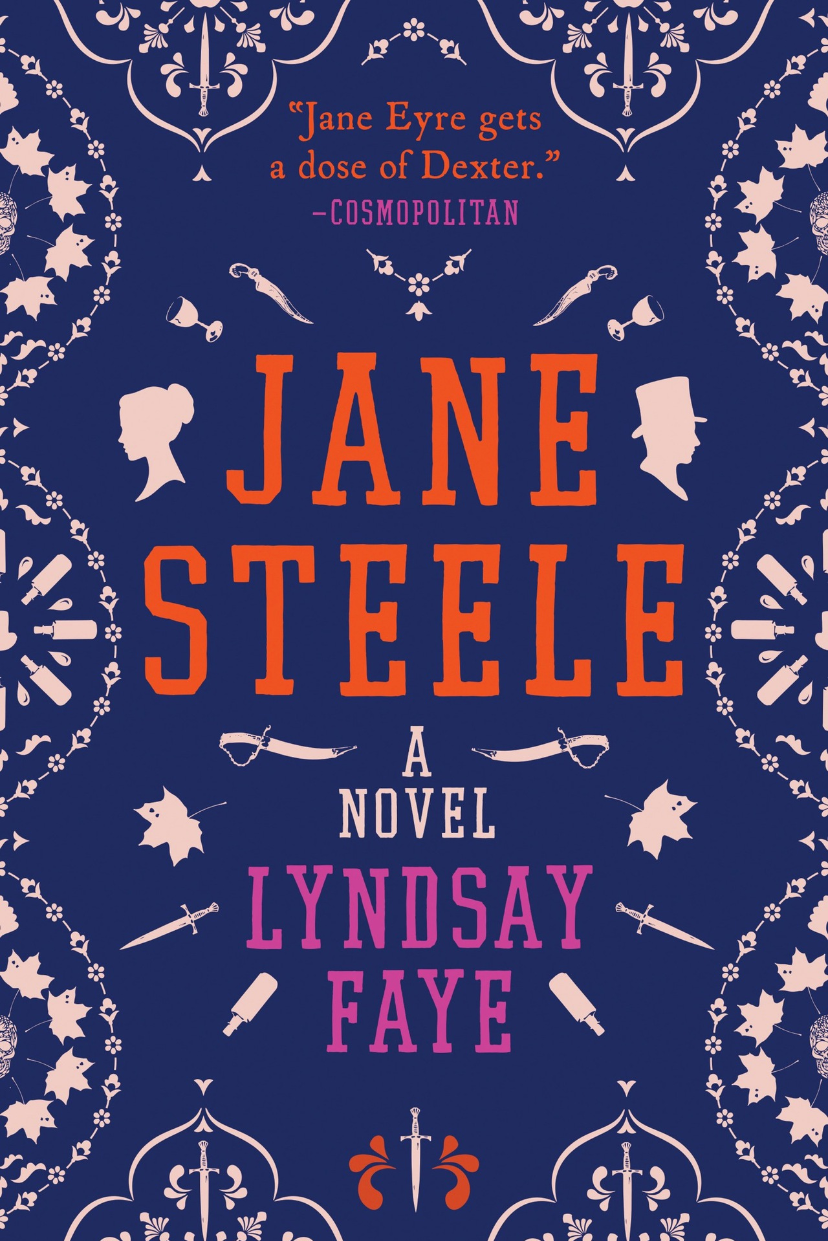
JANE STEELE by Lyndsay Faye

jane-steele-by-lyndsay-fayeI am, for the most part, very much a mood reader. At least until this time of year rolls around, where I become a seasonal reader. Hallowe’en, as we all know, is for horror. December, at least personally, is for science fiction (blame Star Wars books). I’ve never quite been able to figure out what November is for, though.⠀

At least not until a few weeks ago after I finished reading Agatha Christie’s Mystery of the Blue Train. November, I had decided, was for murder. ⠀

Which is why Jane Steele seemed like the best thing to pick up. “Reader, I murdered him,” is a strong enough line to hook anyone and, reader, it hooked me. ⠀

It’s all about the voice. I had read and loved Faye’s Dust and Shadow, her Sherlock Holmes affair, years ago, and the thing that struck me the most about it was how much it nailed the tone and atmosphere of those stories. Her Watson didn’t read like pastiche or homage. It read like Watson. ⠀

I felt similarly after reading this book. This is a Jane Eyre re-telling of sorts, and while I haven’t read that particular classic and so couldn’t tell you if Faye nails that baroque Brontë voice, I can definitely attest to the fact that this story achieves a pitch-perfect Gothic tone, bursting with delicious, melodramatic, murderous undertones.⠀

And although I ultimately enjoyed reading this book (it consists of well-realized, charming characters that positively sing), I did find that the story slowed considerably during the middle, leading to an ending that, while mostly satisfying, also felt a little disconnected to the story we were promised at the beginning. The first handful of chapters crackled with an energy that I found missing from the rest of the book, and I just thought that was a little disappointing.⠀

I still enjoyed reading the hell out of this book, however. It’s a wild ride. I can’t wait to hear the voice Lyndsay Faye captures next.

LOOK BOTH WAYS by Jason Reynolds

look-both-ways-by-jason-reynoldsI only got into Jason Reynolds’ work this year, when I picked up Miles Morales: Spider-Man, a superhero story that has less to do with flashy superpowers and more with the everyday heroism of a brown kid living in Modern America.⠀

I liked it enough to learn more about the guy, looking up speeches and talks. What started out as a bookish crush (Reynolds is an effortless, stylish speaker) quickly turned into a deep admiration as I learned more about the message he is trying to convey with his books, the service he wants to provide with his writing. ⠀

That’s all I think about when I’m writing these books. I’m the lead talker. That’s my job. My responsibility is to look out in the crowd and say, “Where y’all from? What’s your crew? What’s your name?” And to put those names, those neighborhoods, those feelings in a book.⠀

We don’t value how important it is for young people just to see themselves.

Jason Reynolds

His stories are all about being seen.⠀

And I think I’ve seen enough of Jason Reynolds to say that he is one of the most empathic writers working today.⠀

It’s a trait that’s on full display in Look Both Ways, his latest release. A collection of ten stories about different groups of kids on their walk home from school, and everything that happens to them during the way. ⠀

That walk, Reynolds believes, is one of the few experiences kids have where they can feel some sense of autonomy over themselves. Where they can tell and shape stories in their own way, on their own terms. ⠀

One of the things I admire about Reynolds is his ability to effortlessly slip into different — often conflicting — points of view. The characters are as compelling as they are numerous, their stories distinct, each carrying their own flavor and texture. They still interconnect, however, as the lives of these kids weave in and out of each other’s in their own chaotic, impactful fashion.⠀

The amount of topics covered in these ten short stories is truly staggering, and could be overwhelming were it not for the fact that Reynolds has one of the most casual, welcoming narrative voices in literature right now. A voice that can talk about boogers and bullying in the same breath and the same sincerity. But the one theme all the stories ultimately go back to is about being seen.

Every character we meet fits more or less into an archetype: the shy girl, the loner kid, the jock, the nerd, the knuckleheads and the bullies. And Reynolds will tell you their stories. He will tell you why that girl is so shy. He will tell you what that bully’s home life is like. He will tell you how that jock got that black eye. ⠀

He will not tell you everything, though. He won’t fully explain or excuse their actions. But he will tell you just enough for you to be able to look past the label and start seeing them as people.⠀

All he wants to do is make sure somebody else bears witness to his story. That’s all. I can’t do anything for him in that moment. He just wants me to know that this story is his, and that it’s true, and that somebody out of his space can hear it and can take it back into the world.

Jason Reynolds

Because seeing is important. But it’s only ever the first step towards understanding someone else’s story. To do so you must, of course, look both ways, and then cross the threshold.

THE OKAY WITCH by Emma Steinkellner

theokaywitchI began my Hallowe’en reading as gently as possible with Pumpkinheads by Rainbow Rowell and Faith Erin Hicks. I’d figured I’d finish it the same way, and Emma Steinkellner’s The Okay Witch seemed liked the perfect — and perfectly pleasant — bookend.

This middle grade graphic novel tells the story of Moth Hush (the best name), an upbeat but lonely teenage outcast growing up in a small, tight-knit colonial town, who, shortly after turning thirteen, finds out she comes from a long line of witches. Her mother has eschewed magic, however, and is unwilling to talk to Moth about witchcraft, preferring to leave history behind. This is, of course, not acceptable to our teenage protagonist, who is only too eager to find out more about the thing that might make her feel like she belongs. Her exploration into the past mostly spells out trouble, though, and soon stirs up old grudges and grievances.

🎃

Kiki’s Delivery Service is my favorite Studio Ghibli movie (and also, if we’re being honest, probably my favorite film full stop). I love pretty much everything about it: from the story to the setting to the oh-so-lovable characters. It’s a movie that perfectly showcases the kind of everyday, commonplace courage that Miyazaki is so fond of portraying. I got major Kiki vibes from The Okay Witch and that was the main reason I picked it up. And there are similarities, to be sure: they are both endearing and intensely charming stories about young women trying to figure out where they fit in the world. The Okay Witch does its own thing with the premise though, and tells an effective story about prejudice — and, indeed, pride — with characters who deal with the haunted past in varying ways: the townsfolk, who hold it to the highest regard; the witches, who endured years of bigotry and persecution, and understandably wish to leave it all behind; Moth’s mother, Calendula (another best name), who believes in change above all.

And then there is Moth, prepared to push the bad aside, yearning to embrace the good, and perfectly willing to build a better world out of it all. And, like Kiki — one of her literary predecessors — she’s got the kind of courage to deliver it to us, too.

WE SOLD OUR SOULS by Grady Hendrix

soldoursoulsI’ve been reading a lot of stories lately that are more fun than scary. More spooky than horrifying. It’s what I prefer, usually. When I pick up a book, I’m looking for a certain mood and atmosphere rather than anything more visceral. As we get closer to Hallowe’en, though, I start feel that it itch for proper horror, waiting eagerly to be scratched. That’s when I turn to Grady Hendrix, a writer that I know will, like any UPS worker worth their soul, always deliver.

We Sold Our Souls is the story of Kris Pulaski, a former rock star living out her dull and dreary middle age existence as a night clerk in a cheap chain hotel. Kris was the lead guitarist in Dürt Würk, a nineties metal ensemble that never quite made it thanks to the machinations of lead singer, Terry Hunt, who, at the expense of the rest of the group, went on to fame and superstardom. After meeting with another down-on-his-luck bandmate, Kris soon finds out the true circumstances behind Hunt’s meteoric rise: he met the devils at a crossroads and sold the souls of his friends. Fueled by rage and a desperate desire to just understand why, she lights out towards Hellstock ’19, a festival headlined by Hunt that will ostensibly serve as his farewell show, only Kris is certain there are far more depraved designs at hand.

🎃

This is a novel with a recognizable enough premise to be sure, but as the saying goes, still waters run deep, and the sheer amount of themes explored in this novel is enough to take one’s breath away: social class and poverty; conspiracies and mainstream mores; sexism and misogyny; fandom and toxic tendencies; art and commercialism. It is epic and overwhelming in scope, but much like his legendary namesake, Hendrix plays these themes on his guitar with a skillful, experienced hand.

Which bring us to the music.

I always get a kick out of a stories that make me appreciate a subject matter or a subculture in which I hold next-to-no interest. I’m not very into hardcore rock music. I enjoy a handful of songs and bands but, despite my uncle’s best efforts, I’m just not anywhere close to being a metalhead, nor do I have any interest to be. But I’ll be damned if this novel didn’t have me nodding along to the music it was making me hear in my head.

Kris put her fingers on the second fret, strummed, and while the string was still vibrating, before she could think, Kris slid her hand down to the fifth fret, flicked the strings twice, then instantly slid her hand to the seventh fret and strummed it twice, and she wasn’t stopping, her wrist ached but she dragged it down to ten, then twelve, racing to keep up with the riff she heard inside her head, the riff she’d listened to on Sabbath’s second album over and over again, the riff she played in her head as she walked to McNutt’s, as she sat in algebra class, as she lay in bed at night. The riff that said they all underestimated her, they didn’t know what she had inside, they didn’t know that she could destroy them all.

And suddenly, for one moment, “Iron Man” was in the basement. She played it to an audience of no one, but it had sounded exactly the same as it did on the album. The music vibrated in every atom of her being. You could cut her open and look at her through a microscope and Kris Pulaski would be “Iron Man” all the way down to her DNA.

It speaks a lot as to Hendrix’s writing. This heavy metal horror novel is written with such earnestness and fervor that not only do you hear the music being described in the page, it makes you feel it as well. Which is the most important thing: music means nothing without a listener, just as story means nothing without the reader. We must feel what the character feels. In this particular instance, we must hear what the character hears as well. It’s a rough tune, but the message behind it is as sweet as anything.

The blues were about the pain and struggle of living inside Black Iron Mountain. Metal showed you a door.

I first became familiar with Hendrix’s work a couple of years ago with his New Wave throwback My Best Friend’s Exorcism, a book I started because of a Stranger Things-induced eighties binge and finished with a fierce love for the story it told and the characters within it. My experience with this book was similar: I expected it to be good and to enjoy it, but the premise wasn’t one that initially grabbed me. I finished loving it, wholly and completely. Loving the story’s message of hope in defiance of all the horrific, hopeless things that happen within. Loving what it had to say about the importance of creativity and art, and how the human soul truly resides within those concepts.

“Souls are the best part of us,” JD said from the shadows. “Our passions, our dreams. We sell them and lose our creativity, our songs, our spark. We can no longer imagine anything bigger than what’s in front of our faces, we can no longer dream of a better world than Black Iron Mountain.”

At the end, though, what I loved most about We Sold Our Souls was Kris, our indomitable, vulnerable, metal-as-all-hell protagonist. The woman with the axe and the iron will. “A girl with a guitar never has to apologize for anything,” is a refrain repeated throughout the novel. Kris embodies that conceit perfectly, and I already miss reading about her.

KIM HUNT: What’s it like to be a woman in a metal band? Do you face any problems when you’re touring? Is it harder to get fans to respect you? And what about the image of women metal portrays? Do you think heavy metal creates positive role models for women? 

KRIS PULASKI: I don’t know about all that. I just want to play.

— 101.7 WFNX, “FNX Weekends”
March 23, 1994

THE OWLS HAVE COME TO TAKE US AWAY by Ronald L. Smith

owls have come to take us awayThis book disappointed me, but only because the premise and its astounding cover (and its rad title) created expectations so high that they couldn’t possibly be met.

You see, as much as I enjoy books about proper spooky things like ghosts and ghouls, the stories that terrify me the most are ones about aliens. And that’s primarily because I’m not much of a believer in the supernatural. I don’t think scary monsters and sprites actually exist. Extraterrestrial life, though? Um, yeah. And extraterrestrial life paying us visits? Well… still not much of a believer there, either, but it’s certainly not outside the realm of possibility. And if there is even a small chance… well, that creates enough of a suspension of disbelief in me to be able to generate a good and proper scare.

It’s the implication of it all, I think. Either these things are actually happening in real life, or they are happening entirely in people’s heads. Your opinion may differ, but it’s the latter possibility that I find most disquieting. Monsters from outer space are peculiar in that regard. Because, in the general opinion at least, the people who witness and believe in them tend to be considered… not mentally well. Ghosts and demons? Well, obviously you are in need of spiritual help. Aliens? You probably need medication. It’s a little unfair, and more than a little problematic, and that’s an aspect that is explored in Ronald L. Smith’s The Owls Have Come to Take Us Away, the story of Simon, a biracial boy growing up in a military base, whose main preoccupation in life happens to be aliens — Gray aliens, to be specific (a fear that originates with Whitley Strieber’s book Communion, which I can identify with as that book also absolutely terrified me). It’s a worry that erupts into full-blown fear while on a camping trip with his parents, where he goes through an experience that he believes to be an actual alien abduction.

🎃

Belief is the key term here. His parents — a doting and overly-concerned mother and an emotionally distant, callous father — soon find out, quickly assume the problem to be a psychological one, and he is promptly sent to be checked out by a doctor. And this constitutes the main conflict of the story: did this all happen to Simon in real life, or was it all inside his head?

Does it matter either way?

It’s an interesting and promising premise, but one with which, unfortunately, Smith doesn’t really do a whole lot. There are a lot of themes to be discussed within it, ranging from the importance of mental health awareness all the way up to toxic masculinity and its effect on young men. These topics are touched upon in the story, but only — frustratingly — on the most superficial of levels.

And I get it — this is a middle-grade novel, which can present a number of restrictions: from the way you write about certain topics to just how much you can discuss them without losing the interest of the younger audience. Writing about serious subjects well in children’s fiction demands a delicate balance, but it’s one I’ve seen struck successfully before, and often enough to not feel let down when coming across a story that doesn’t seem entirely willing to make the effort.

Which isn’t to say there aren’t any redeeming qualities in the story. Smith’s writing is economical and immediate. And while I don’t think he delved into the themes as much as he could have, he does allow us to view them through a more traditionally fantastical lens, with a story-within-a-story that is ostensibly being written by Simon, excerpts of which are peppered throughout the novel, and the writing for it is lavish and lofty and impressive. The metaphoric meaning behind it is not entirely subtle, but I found it to be an effective device, and these extracts were my favorite part of the story. I wouldn’t mind if Ronald L. Smith pulled a Rainbow Rowell and built an entire book around this nested narrative.

Smith also writes characters that are honest and compelling. His protagonist, especially. It’s easy to love and feel for Simon, who spends most of this story smothered and trodden — by the adults around him, by the aliens he believes are invading his life. In the end, Simon is just someone who wants to be seen and heard. Someone who just wants validation. The story gives it to him, and I can’t fault it for doing so. Because kids like Simon need spaces to breathe — spaces where they can just simply exist — and they deserve more stories that can provide that for them.